How To Teach Your Dog the Place Cue


Our dogs love to be part of the household action, but sometimes it’s easier to have them anchored in one spot instead of right beside you. That’s where how to teach a dog “place” will come in handy.
Teaching dogs to go to a specific spot, like a dog bed or rug mat, is a great way to keep them out from underfoot and safe. Plus, it’s an impressive skill. Even better, it’s fun to teach!
Key Takeaways
- Teaching your dog the “place” cue is useful for managing their behavior.
- The cue helps keep dogs safely out of the way while staying engaged and relaxed.
- Training the cue involves shaping, repetition, and over time, adding distance and distractions.
- Once mastered, the “place” cue can be applied in many everyday scenarios, from staying out of trouble at home to keeping safe while traveling.
How To Teach a Dog To “Go to Place”
Unlike most other basic training cues, dog mat training requires your dog to use some creativity, especially during the beginning stages. It’s sort of like a game of hot and cold—a process known as shaping—where your dog figures out that interacting with the mat earns a treat.
From that point, the behavior gets more complex and includes staying on the dog bed or rug mat in a comfy position for an extended period. As your dog gets more fluent with the cue, they’ll learn to “go to place” no matter where it, or you, are located.
Gather a pocket full of tasty treats, your dog’s bed or mat, and an eager canine student! The following steps should be broken into short training sessions so your dog stays happy and engaged throughout.
1. Choose Your Dog’s Place
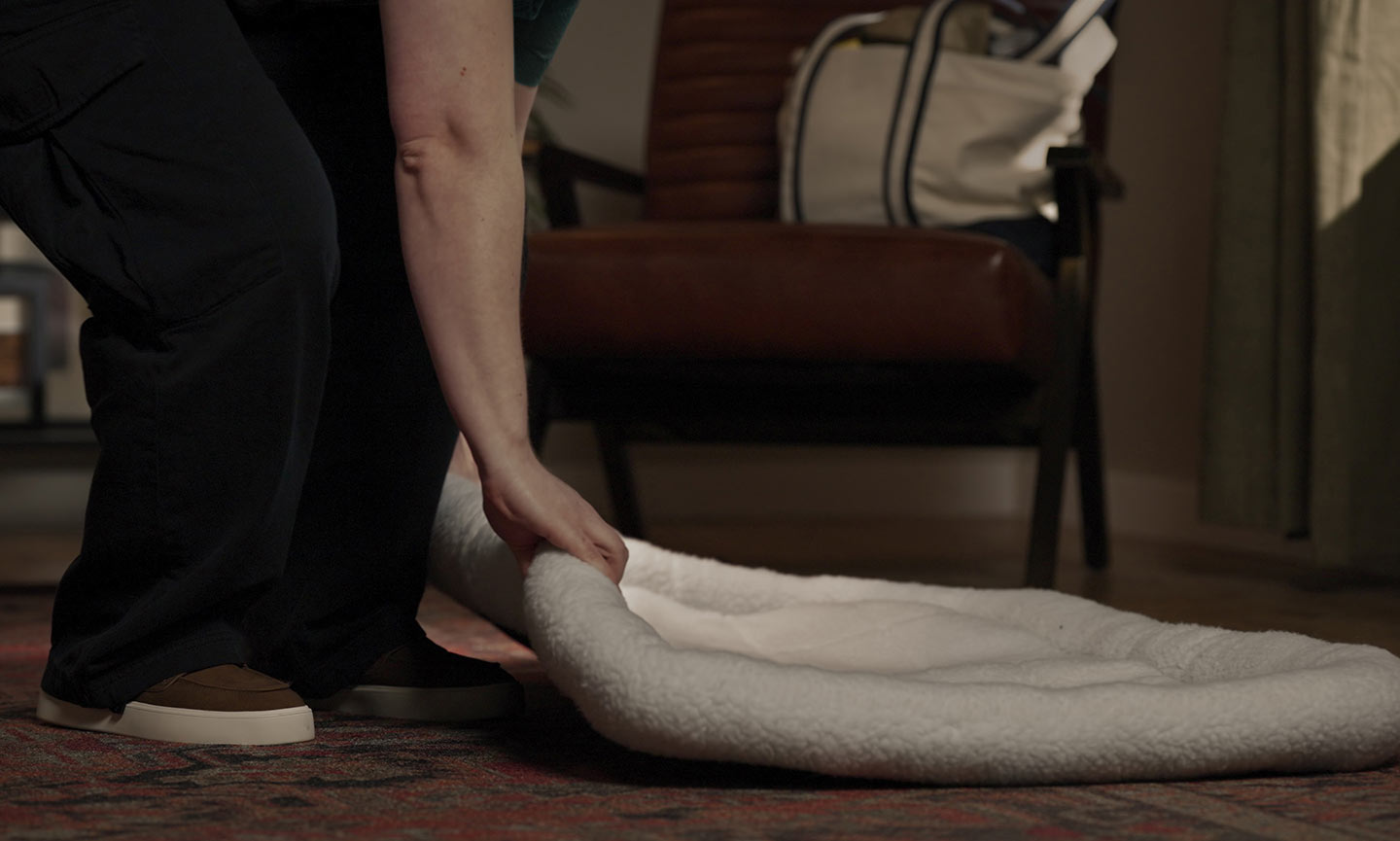
Photo by Chewy
Start by selecting an obvious spot for your dog to settle, like a dog bed, rug, or floor mat.
Recommended Products

If you’re using a rug or floor mat, practice the cue on a surface that’s different from the mat during the beginning stages, like a room with a tile floor instead of carpet. This makes it easy for your dog to feel the difference between the mat and the floor.
2. Reward Your Dog for Interacting With Their Mat
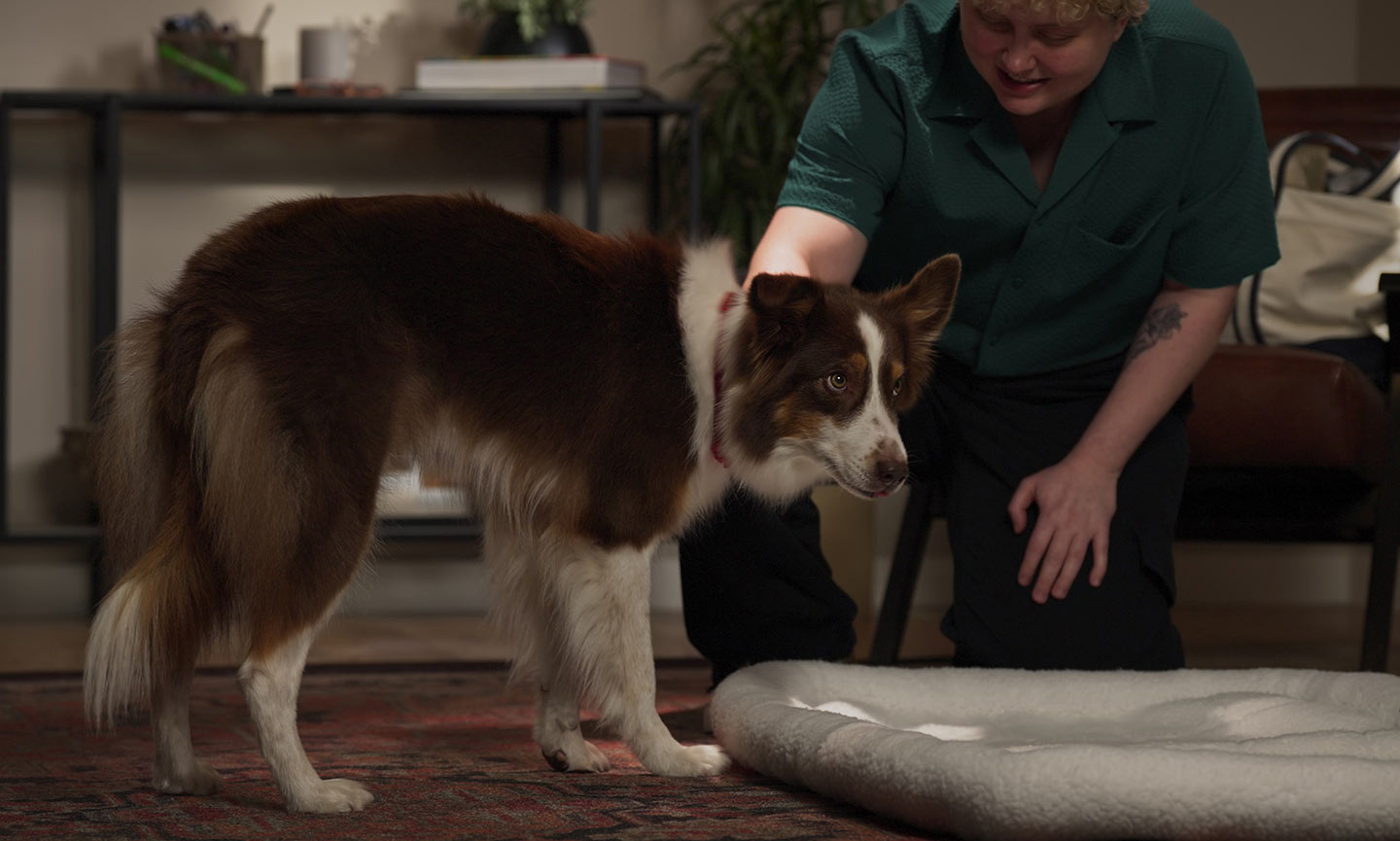
Photo by Chewy
The first goal is for your dog to understand that any interactions with the mat can earn a treat. That even includes glancing at it!
Set your dog up for success by standing near the mat. Then, whenever your dog shows interest in it, either by looking at it or taking a step toward it, mark it with a specific word like “yup” and then immediately follow up with a treat.
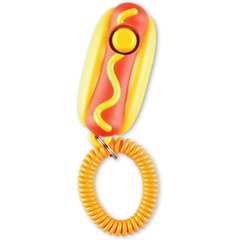
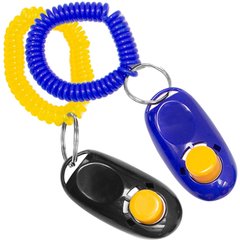
You can also use a clicker to mark the moment your dog shows interest in the mat, then give a treat.
Recommended Products
It’s tempting to give your dog hints during the early stages, like luring them to the mat with a treat, but it’s best to let your dog figure it out on their own.
Remember that at this stage, even the slightest interest in the mat can win a treat. Even accidental touches are wins during the early stages. Every reward is telling your dog, “You’re getting warmer.” The more information you can give your dog about what works to get rewarded, the quicker the process will go.
3. Raise Your Criteria as Your Dog Repeats Behaviors
With a bit of practice, your dog will probably figure out that interacting with the mat earns rewards and will start being more obvious about being near it. At this stage, when your dog starts repeating interactions with the mat, it’s important to raise your criteria for rewardable behavior.
Any time your dog begins repeating a mat behavior, pause and wait for more before you mark the behavior with a “yup” and treat. For example, if your dog has gotten good at putting one paw on the mat, don’t reward that behavior; wait for something bigger. (Otherwise, you’re just training your dog to touch the mat and nothing more.)
It’s likely that your dog might seem to say, “Can’t you see what I’m doing here?” and be more deliberate—and put two paws on the mat instead of one. That’s major progress.
Once they have two paws on the mat, hold out for three. When they’ve mastered that, hold out for all four. Once your dog figures out that standing on the mat is a good thing, pause and wait for them to do something else, like a sit or a down on the mat.
It’s tempting to ask for a sit or down, but it’s more powerful if your dog figures it out on their own. The final cue of “place” means your dog needs to go to the mat and get comfy, so telling your dog to move into a sit or down would add a step to the process.
4. Add a Reset Treat to Encourage Repetitions
When your dog is readily getting on the mat, begin tossing the reward a short distance away from it to reset your dog for another repetition. The rhythm might be:
- Your dog gets on the mat and sits.
- You mark the sit by saying “yup,” and then throw the treat a few feet in front of the mat.
- Your dog will likely grab the treat and immediately run back to the mat.
Once this step is happening consistently, it’s time to start naming the behavior.
5. Introduce the Cue Word
The next time your dog heads for the mat, say your word of choice, like “mat” or “place,” as they’re on the way to the mat. This is making a connection between the action and the cue—you’re basically teaching your dog English.
It’ll take about 20 repetitions before your dog starts associating the behavior with the word. At that point, you can start asking for the behavior by saying your cue word. If you’ve been consistent, you’ll be able to stand near the mat, say your cue, and your dog will run there and get comfy.
Success! You’ve taught the foundational steps, and now it’s time to level up.
6. Add Distance Between You and the Mat
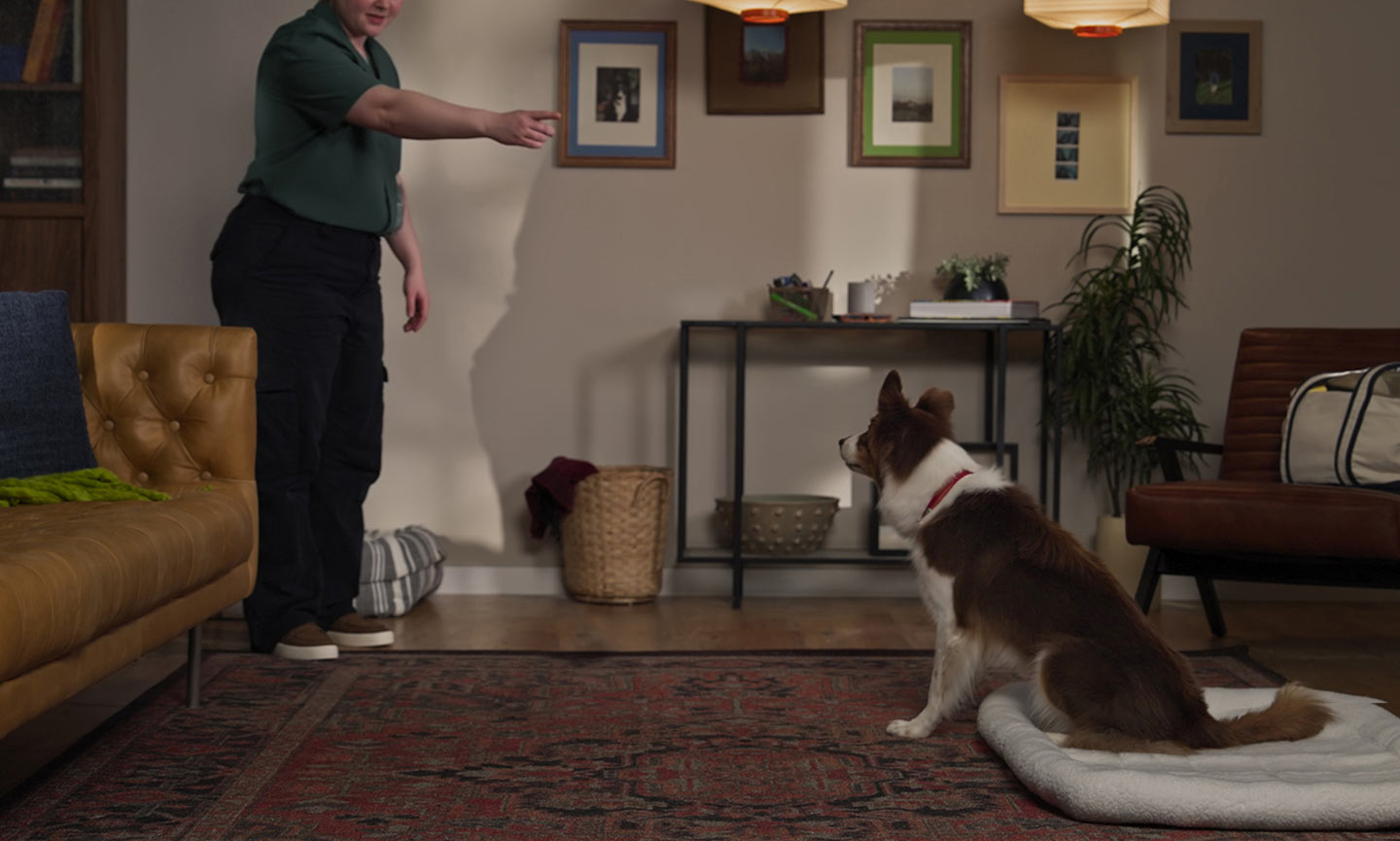
Photo by Chewy
The two aspects that make place training more challenging are adding distance and distractions.
Think about it: When you send your dog to their place, you probably won’t be standing right beside the mat. Plus, you’ll often be asking your pup to hang out there for a while, so getting them used to relaxing on the matwithout you right there is an important part of training.
First, work on adding distance. Each time you toss a reset treat after your dog has successfully gotten on the mat, take a step away from it before your dog returns.
At a certain point—often when you’ve gone a couple of feet away from the mat—your distance from it requires your dog to make a leap of faith. They’re probably used to seeing you close to it and might not understandthat you’re still playing the game if you’re too far away. If your dog pauses before getting back on the mat, give them a minute or two to process the change, and try not to give too many hints as you wait.
Then start varying your distance and position to the bed. On some attempts, stay close. On others, move farther away. Try positioning yourself to the side of the mat or behind it, so your dog starts to understand that nomatter where you are, the cue “place” means to get on the mat.
7. Add Real-Life Distractions
Once your dog is reliably going to their place regardless of where you are in relation to it, it’s time to add some real-life distractions.
Try sending your dog to “place,” and then walk away to look at your mail, leave the room for a few seconds, or load the dishwasher. To make it extra tough, try sitting on a nearby chair. The goal of adding distractions is to help make your dog comfortable responding to the cue no matter what’s going on.
There are so many ways to incorporate the place cue into your everyday life, from keeping your dog anchored when you answer the door to getting them out from underfoot while you prep dinner. Dog mat training is a fun exercise to teach, plus it’s incredibly helpful in a bunch of ways. Give it a shot, and prepare to be impressed.
Attributions