English Springer Spaniel
Updated July 1, 2026

English Springer Spaniel
Updated July 1, 2026
Loyal and playful, the English Springer Spaniel thinks you’re just great. Better than great. Fabulous. This dog knows you’re their best friend, and they’ll treat you as such. Just make sure you give them love in spades and lots of opportunity for fun adventures.
Athletic, Sidekick, Social
40–50 pounds
19–22 inches
12–14 years
Black and White, Black White and Tan, Liver and White, Liver White and Tan, White and Liver, White and Black
Just look at those fabulous wavy ears flying in the wind—was anyone ever more carefree? English Springer Spaniels are upbeat, social dogs with a love of people and adventure.
These loyal pups would stay active from sunup to sundown if you’d let them, and they’d prefer that you never leave their side—you’re OK with that, right? If you really must go to work (whatever), promise them an extra-long weekend hike and additional evening—and yes, they’re allowed on the couch. Just try saying no to those puppy eyes. (Impossible.)
English Springer Spaniel Characteristics
English Springer Spaniel Appearance
The English Springer Spaniel dog breed has a compact body and athletic build. Their moderately long coat has feathering on their long, flappy ears, chest, and backside.
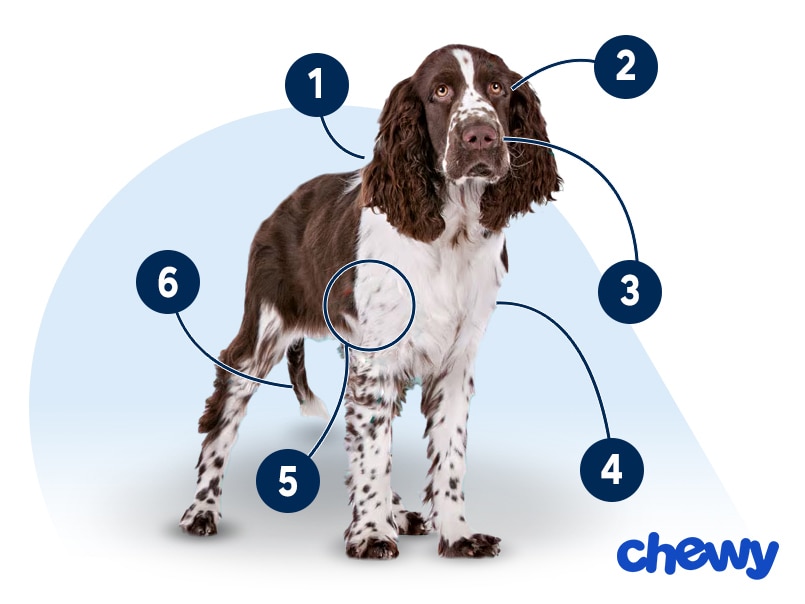
- Ears
Their ears are large and droopy and hang close to the side of their head to help them collect scents while hunting.
- Eyes
In liver (brown) and white dogs, their oval eyes can be dark hazel. In black and white dogs, the eyes can be black or deep brown.
- Nose
The English Springer Spaniel has a black or liver nose.
- Coat Length
Springers have long, thick, and rich double coats with feathering on the ears, chest, and legs. Their outer coat is medium length and flat or wavy; their undercoat is short, soft, and dense.
- Coat Color
English Springer Spaniel coats come in a range of colors, including black or liver with white, blue, or liver roan (an even mix of white and colored hairs), and tricolor (tan, white, and liver, or white, black, and tan).
- Tail
While it was once common to dock a tail, nowadays many of these pups have their tails intact. Many groups, including the American Veterinary Medical Association, oppose tail docking, and many countries as well as U.S. states have banned the practice.
English Springer Spaniel Temperament
High-spirited and social, the exceptionally loving English Springer Spaniel truly believes in the motto, “the more, the merrier.”
This energetic pup loves to be with their people—and their people’s people, and anyone beyond that. They’ll probably get along well with kids, too.
They appreciate it if you can hang with them for most of the day, so if you tend to work long hours, you’ll need to consider doggy daycare or a dog walker.
These pups are sporty and playful, and they need to get outdoors to be the best version of themselves. They have a curious, intelligent air that can best be fulfilled by spending time in nature.
Related Breeds








How to Care for a English Springer Spaniel
The English Springer Spaniel dog’s double coat needs brushing a few times a week, and this lovable dog will need plenty of exercise every day.
Grooming
Training
Diet
Exercise
Environment
English Springer Spaniel Health
The average English Springer Spaniel lifespan is 12–14 years. Here are some health issues to be aware of.
- Elbow and hip dysplasia: Elbow and hip dysplasia are genetic conditions that develop during puppyhood when the joints don’t align well and become looser than normal. Signs include limping, and treatment might involve weight loss, reduced activity, joint supplements, physical therapy, pain meds, or, in severe cases, surgery.
- Ear issues: Big, long, and fluffy, English Springer Spaniel ears are adorable—but they can trap moisture inside, which can lead to many issues. Thoroughly drying after baths or outside playtime can help. If you think your pup has an ear infection, talk to your vet; they may also recommend weekly ear cleaning to prevent infections.
- Epilepsy: These dogs are prone to seizures caused by epilepsy, which typically begins between six months and 5 years old. It’s treated with lifelong medication.
- Phosphofructokinase deficiency: This metabolic disorder is hereditary, and symptoms include blood in the urine; fatigue or weakness; depression; fever; and exercise intolerance. Your veterinarian will do a full workup to diagnose your dog. The only current treatment is a bone-marrow transplant.
- Progressive retinal atrophy (PRA): PRA leads to blindness in dogs, and while there is no cure, pups who lose their eyesight tend to adapt well and live full, happy lives.
English Springer Spaniel History
The English Springer Spaniel is from England, but they likely have origins in Spain—hence the name “spaniel.”
Each type of spaniel was born to hunt birds, and each one had their own strengths.
English Springer Spaniels and English Cocker Spaniels were originally the same breed: Springers were the larger pups of the litter and were used to spring birds from the brush. English Cocker Spaniels were the smaller pups, and their mission was to flush out woodcock, a quail-like bird, from its hiding place in dense thickets.
The American Kennel Club recognized the English Springer Spaniel in 1910.
English Springer Spaniel puppies can cost thousands of dollars. If you choose this route, pick a responsible breeder.
Adoption is also great, as there are many of these pups patiently waiting for a forever home. Look for an English Springer Spaniel rescue like Springer Spaniel Rescue, keep an eye out for the breed at your local shelter, or search Chewy’s database of adoptable dogs in your area.