Polydactyl Cats: 7 Facts About Cats With ‘Thumbs’

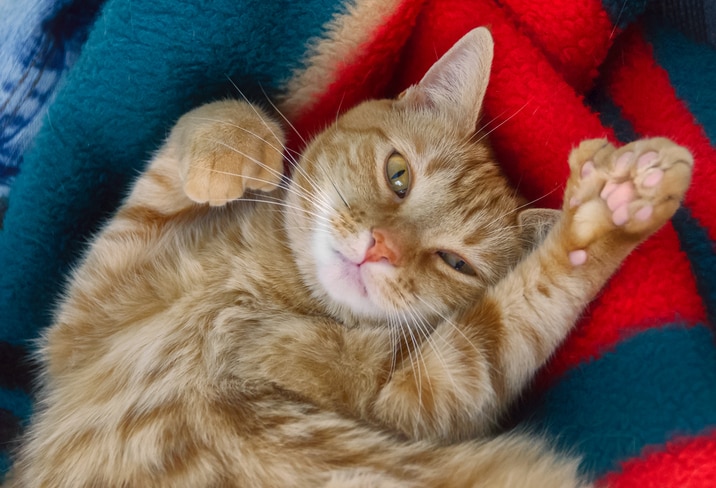
Photo by Ed-Ni-Photo/iStock/Getty Images Plus
All cats are unique, but there’s just something extra special about polydactyl cats. These felines have a genetic mutation that gives them a distinctive look—extra toes, that is.
Wondering what makes these cats who they are? Here are seven fun facts about polydactyl cats.
Key Takeaways
- Cats normally have 18 toes, but polydactyl cats have extra toes due to a genetic mutation.
- The number of extra toes can vary and might be anywhere on the paw.
- Polydactyl cats need more frequent nail trims to prevent their extra nails from becoming overgrown and damaging the paw pads.
- Some polydactyl cats have improved balance and stability since their extra toes mean they have a wider paw.
1. Polydactyl Cats Are Called ‘Cats With Thumbs’
Cats with extra toes—more than 18—are considered polydactyl, a word that simply means they have more than the usual number of fingers or toes; it’s used for humans too.
A cat’s extra toes are often smaller than the normal toes, which makes them look like thumbs. This is where the nickname “cats with thumbs” comes from. These cats are also affectionately referred to as mitten cats, mitten-footed cats, and boxing cats.
2. Polydactyl Cats Have a Genetic Mutation
Polydactyl cats have extra toes due to a mutation in the gene that regulates toe development. Since it is genetic, the trait is passed down from mother cat to kitten.
Usually, cats have five toes on each front paw and four toes on each back paw.
In polydactyl cats, the number of extra toes—and its location on the paw pad—can vary widely. Some extra toes are on the outside of the paw, while others are on the inside. Rarely, extra toes can even be in the center of the paw pad.
What’s more, cats may be polydactyl on a single paw or multiple paws.
3. Polydactyl Cats Are Legends in Key West
If you’ve visited Key West in Florida, you might know that polydactyl cats are legends there. It’s mostly thanks to 20th century writer Ernest Hemingway.
He kept many polydactyl cats when he lived there, and now The Hemingway Home & Museum houses about 60 descendants of those cats, lovingly called “Hemingway cats.”
4. Polydactyl Cats Are Considered Good Luck
While it’s just a rumor, polydactyl cats do have a reputation for being good luck. Sailors believed these cats brought positive energy to ships, and they praised them for their keen ability to keep the high seas rodent-free.
It might just be a myth, but you can still consider your polydactyl friend your good luck charm.
5. Polydactyl Nails Need Special Care
A polydactyl cat’s extra toes are generally smaller and not functional, so the claws may not wear down like those on typical longer toes.
This increases the risk for long, overgrown nails that curl into the paw pads. That condition can lead to significant pain and even infections if left untreated.
To prevent this, polydactyl cats need more frequent nail trims. Try a nail clipper like the Necoichi Purrcision Cat Nail Clipper or the Frisco Nail Clippers for Cats & Small Dogs.
Recommended Products


Between nail trims, look at your feline’s paw pads to make sure their nails have not grown into them or caused any damage.
6. Polydactyl Cats Are Very Well-Coordinated
Some polydactyl cats are better at balancing, but this is not always the case. It actually depends where their extra toes are located and how good your individual cat’s mobility is.
However, when extra toes do help balance, it is usually because the unique paw is a little wider than normal, which improves the cat’s grip and provides them a greater surface area to spread their weight.
So, if your cat tends to be extremely well-coordinated, it might just be that extra paw putting in the work.
7. No Two Polydactyl Cats Are the Same
Polydactyl cats are all unique individuals—no two are the same.
Even if they have the same number of extra toes, the locations on their paw pads will be different and unique to their genes.
So, if you have a polydactyl cat, you can appreciate that you have one special feline.
FAQs About Polydactyl Cats
Are polydactyl kittens rare?
Polydactyl kittens are quite common, but they are found most frequently in specific locations, such as Key West. Since it’s an inherited trait, it makes sense that they’d be clustered together.
What cat breed is most likely to be polydactyl?
The Maine Coon and Pixiebob cats are most likely to be polydactyl compared with other breeds.
What’s the lifespan of a polydactyl cat?
The typical polydactyl cat lifespan is similar to any cat, about 13 to 17 years.
How many toes does a cat have?
A normal cat has 18 toes, while a polydactyl cat has more than 18 toes.