Bengal Cat
Updated February 5, 2026
Bengal Cat
Updated February 5, 2026
Known for their exotic coats and spunky personalities, Bengals are a cross of the Asian leopard cat and the domestic house cat. They make friendly, sociable pets—especially the later generations—but their intelligence requires lots of engagement, playtime, and attention.
Whip-Smart, Energetic, Curious
6–15 pounds
12–17 years
If you’ve dreamt of having an exotic, wild-looking cat with the loyalty and playfulness of a dog, a Bengal may be your next best friend.
This breed is a blend of the wild Asian leopard cat and the domestic cat. The result? A highly intelligent, extremely curious, and super friendly feline who’ll want to spend every minute with you. And with their beautiful rosette spots or marbled coat, these cats are as striking to behold as they are fun to be around.
But the Bengal cat breed personality can vary based on the generation of the cat:
- F1 Bengals are first-gen Bengals, meaning one parent is an Asian leopard cat and one is a domesticated cat.
- F2 Bengals are the grandchildren of an Asian leopard cat.
- F3 Bengals are the great-grandchildren of an Asian leopard cat. They, along with F4 Bengals, are still considered “early generation.”
- F5 Bengals are considered fully domestic. Some areas in the U.S. ban Bengals belonging to earlier generations.
Bengal Cat Characteristics
Bengal Cat Appearance
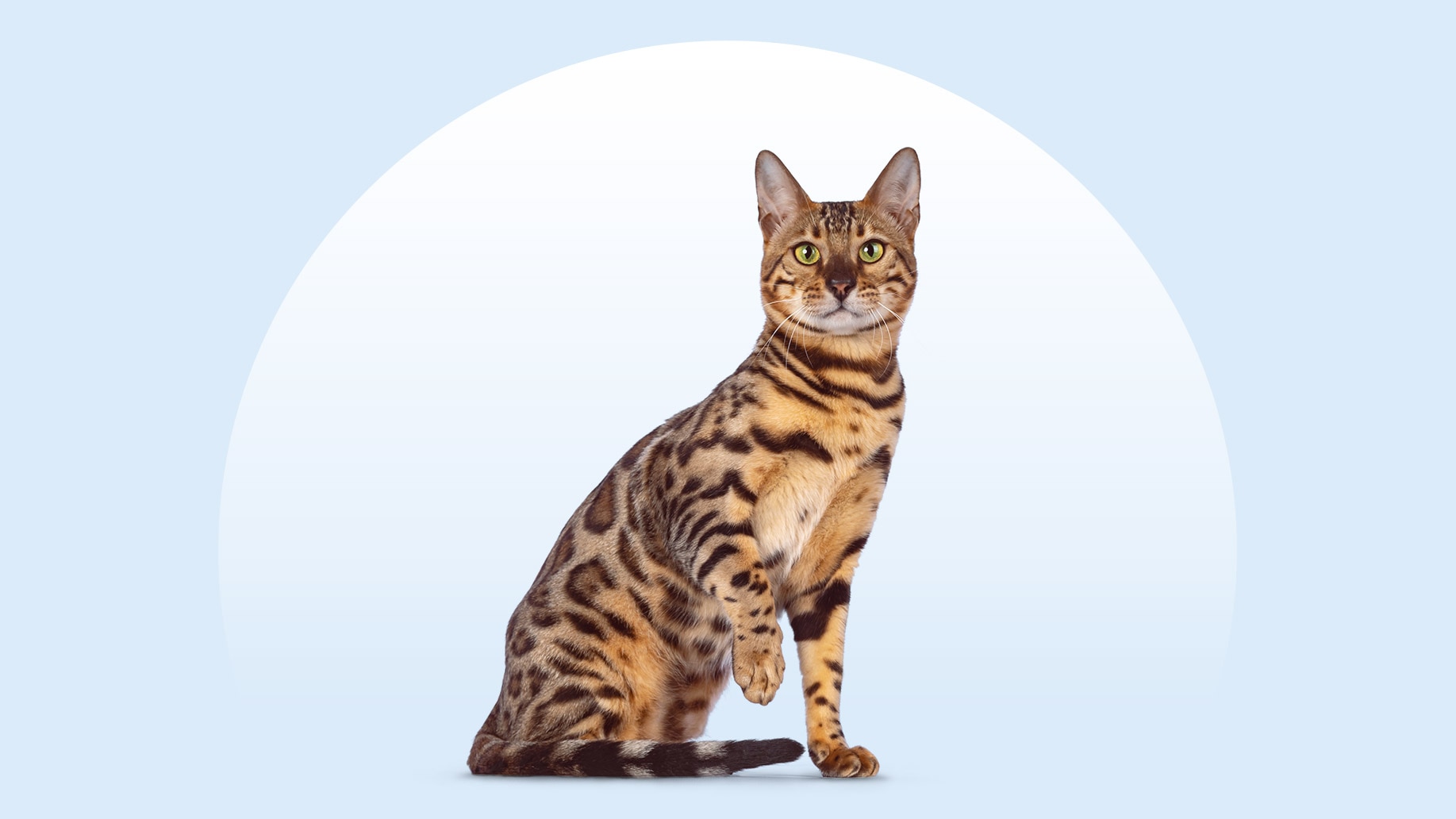
The Bengal cat characteristics are arguably some of the most striking of any cat breed. Known for the vivid spots or marbling on their short, luscious coat, Bengals have inherited an exotic appearance from their wild ancestors.
The Bengal size is lean and slender, with an athletic build that keeps them poised for the active lifestyle they prefer.
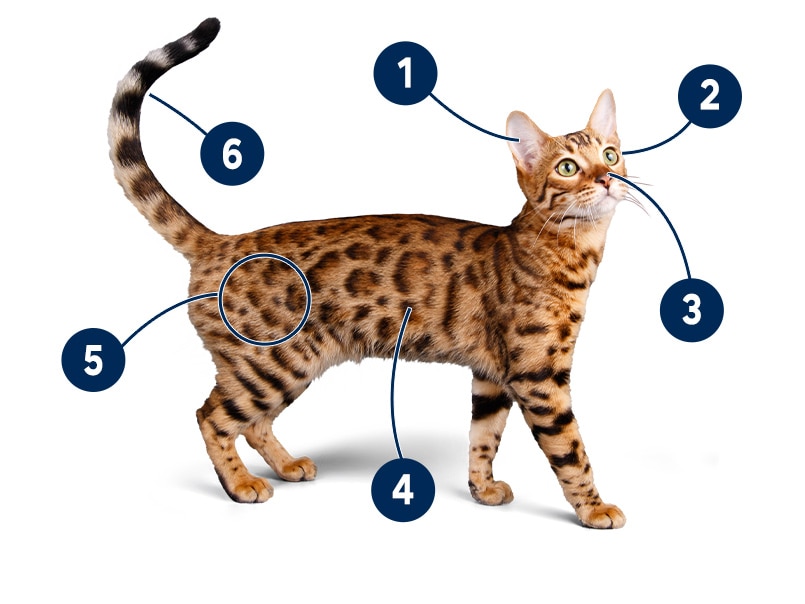
- Ears
A Bengal cat’s ears are small to medium in size, with a wide base and rounded points. They may have ocelli (eye-shaped markings on the back of their ears).
- Eyes
They have large, round eyes set wide apart.
- Nose
They have wide noses surrounded by prominent whisker pads.
- Coat Length
The Bengal cat breed has a short, silky coat that seems to glitter in certain light. Bengal kittens may have slightly longer coats.
- Coat Color
Bengal cat colors include brown, silver, blue, snow, charcoal, seal, and black. Their coats either have marbling or rosette spots, which are large with dark rings around them and resemble the spots on wild cats.
- Tail
Their tail is thick, low-set, and rounded at the end.
Bengal Cat Temperament
Bengals tend to be friendly, high-energy cats who are incredibly smart and insatiably curious. Many are happy to cuddle and sit in your lap, and they’ll express their love—and their needs—with generous vocalization.
The Bengal cat personality can be almost doglike, says Cherie Hubbard, a North Carolina-based breeder who has been breeding Bengals for 14 years.
“They will follow you around the house like a dog,” she says. “That’s one of the most endearing things that people love about them, is that they just want to be with you.”
Bengals are a highly intelligent breed, which can get them into trouble if they’re not adequately stimulated. If they’re bored, a Bengal may tear at furniture or try to open cabinets. Pet parents should help direct their intelligence by providing them with plenty of enrichment.
“They observe, they watch, they learn things very quickly,” says Marilyn Krieger, certified cat behaviorist and author of the book Naughty No More!
“You can’t just leave them alone without anything to do,” Krieger says, “because they will find things to do.”
Related Breeds



How to Care for a Bengal Cat
Bengals are naturally active, generally healthy cats. Because of their short, low-shed coat, they require minimal grooming and can even be good for homes with cat allergies (but remember that no cat is 100% hypoallergenic).
Pet parents will spend most of their time keeping their smart and curious Bengal occupied with activities and exercise.
Grooming
Diet
Exercise
Environment
Bengal Cat Health
Like many cat breeds, Bengals can live well into their teens. The average Bengal cat lifespan is 12–17 years, and some can live longer.
These cats are generally healthy, but they are predisposed to a handful of health issues that can be detected through testing. When looking at Bengal cats for adoption or purchase, opt for responsible breeders certified by the International Cat Association (TICA) and ask about genetic testing.
- Progressive retinal atrophy (PRA): This genetic disorder affects the cat’s retina and can lead to blindness over time. PRA is relatively rare, but Bengal breeders should test for it, as the breed is predisposed to the condition.
- Pyruvate kinase (PK) deficiency: PK deficiency prevents the red blood cells from metabolizing properly, leading to blood-related issues like anemia, and symptoms such as weakness and elevated heart rate. This genetic defect can and should be tested for, as PK deficiency can dramatically reduce the Bengal life expectancy.
- Hypertrophic cardiomyopathy: Bengals should be screened for hypertrophic cardiomyopathy, a condition that causes the muscular walls of the heart to thicken. This makes it harder for blood to pump efficiently, and may result in congestive heart failure or potentially life-threatening blood clots.
- Feline lower urinary tract disease (FLUTD): Cats who don’t get enough water can develop FLUTD, an umbrella term for several conditions that cause pain and discomfort for your cat, and may lead them to go outside of the litter box. Treatment for FLUTD can vary by condition and cat, but may include increasing water intake, adding more litter boxes to the home, or administering antibiotics. In some cases of FLUTD, surgery may be required.
Bengal Cat History
Bengal cats were first bred in the 1960s by a breeder named Jean Mill. At the time, the Asian leopard cat was facing severe poaching. Mill hoped that by creating a domestic version of the Asian leopard cat, people would develop greater empathy and respect for the cats in the wild, and that illegal hunting would go down.
To create the Bengal, Mill bred a domestic tomcat with an Asian leopard cat. She continued backcrossing Bengals until she reached a fifth-generation cat with an exotic look and a gentle temperament.
The Bengal takes its name from the Asian leopard cat’s scientific name, Prionailurus bengalensis. The breed has been formally recognized by TICA since 1986.