Savannah Cat
Updated February 3, 2026
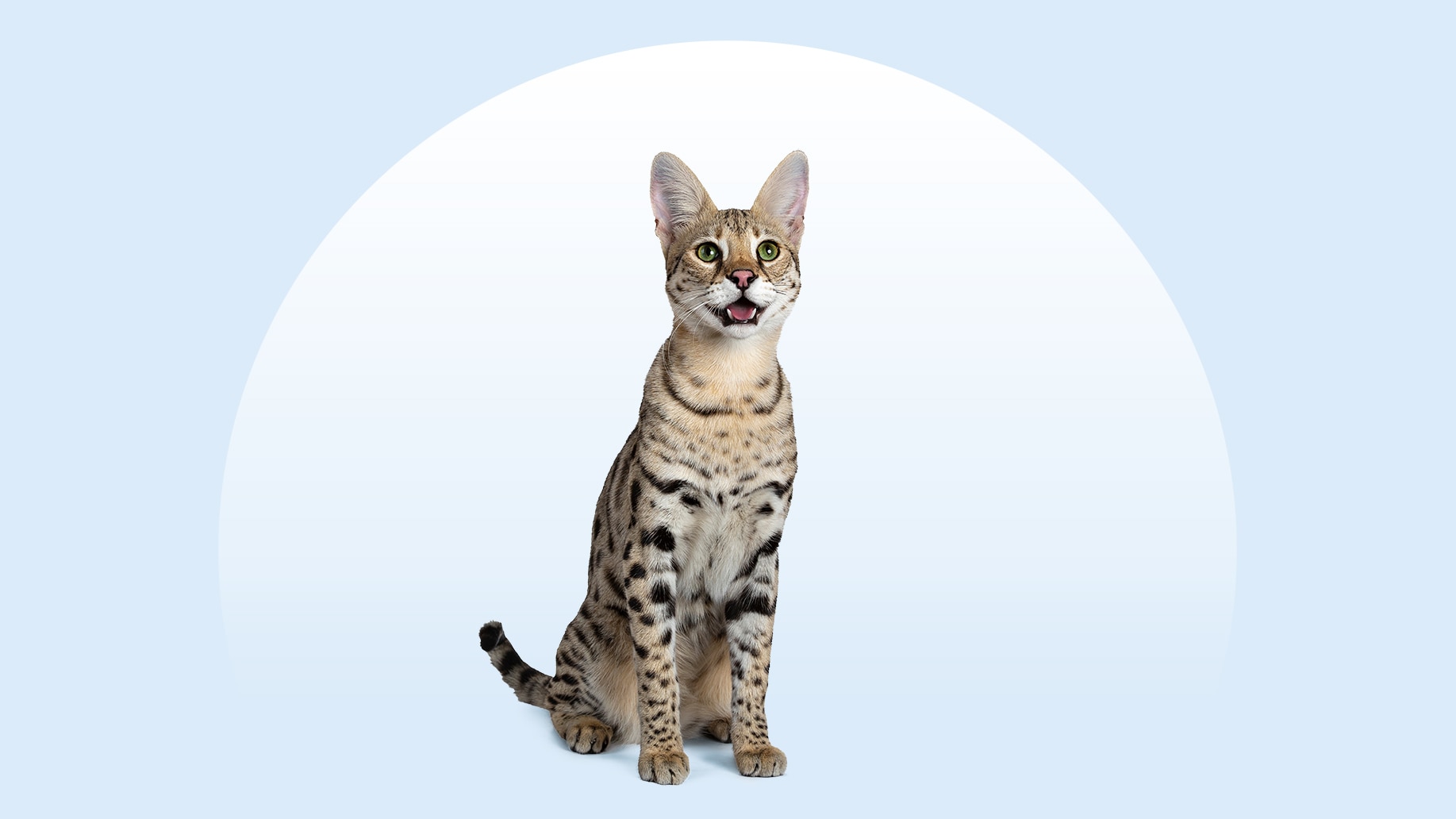
Savannah Cat
Updated February 3, 2026
The Savannah cat is a wild-looking, hybrid cat known for intelligence, athleticism, and doglike loyalty. These big cats are best suited for experienced pet parents who can meet their high energy and enrichment needs.
Playful, Adventurous, Loyal
11–20 pounds
12–15 years
Spots and stripes, nimble and bright. There’s so much to admire about a wild cat; don’t you wish you could have one for yourself? We’ve got a possible solution for you: Meet the Savannah cat. All the wow of the wild, minus the danger.
Savannah cats are a cross between a wild African Serval cat and a domestic cat, which gives them their bold spots, long legs, and athletic build.
They’re also wicked smart, curious, and outgoing. If you’re an experienced cat parent looking for a playful companion who will keep you on your toes, the Savannah cat might be a good match.
Savannah Cat Characteristics
Savannah Cat Appearance
The Savannah is a large cat who would be hard to miss in the wild (that is, at the local vet or strolling by on a harness and leash). With bold spots, long legs, oversize ears, and a tall and athletic build, their striking silhouette is unlike any other domestic cat breed.
In fact, the Savannah cat is the tallest domestic cat. As of 2026, the record for the tallest living domestic cat is held by Fenrir, an F2 Savannah cat who stands an impressive 18.83 inches tall. To put that in perspective, the average house cat typically stands 9–10 inches tall.
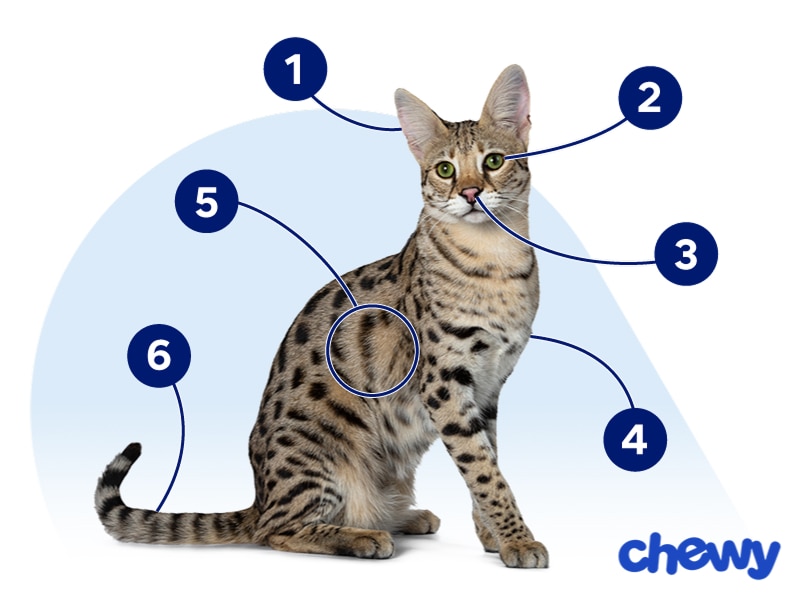
- Ears
Savannah cats have large, upright ears set high on their heads. The ears are rounded at the tips and may have soft, protective hairs on the inside (called ear furnishings) but lack ear tufts.
- Eyes
Savannah cats have small to medium eyes set slightly at an angle, with the outer corners sloping downward toward the nose. Eye color can vary widely and includes shades of green, gold, copper, and hazel. Many Savannah cats have dark markings called tear lines or “cheetah tears,” which run from the inner corner of the eye toward the whiskers.
- Nose
Savannah cats have a wide nose.
- Coat Length
Savannah cats have a short- to medium-length coat with coarse guard hairs layered over a soft undercoat. The coat is not dense and lies relatively flat against the body, with spots that are softer to the touch than the surrounding base coat.
- Coat Color
Savannahs have one recognized coat pattern: bold, cheetahlike spotting. Their solid, dark-brown-to-black spots may be round, oval, or elongated, and appear on a golden-to-silver base coat.
- Tail
Their tail is medium in length and tapers to a blunt end rather than a wispy tip.
Savannah Cat Temperament
When it comes to hybrid cats, temperament is closely tied to their filial (F) generation. This ranking tells you how many steps removed a Savannah cat is from their wild African Serval ancestor.
For instance, F1 Savannahs have one Serval parent (making them approximately 50% wild) while F3 Savannahs are three generations removed from their pure Serval great grandparents and have lower levels of Serval genetics (the specifics depend on how they are bred).
Because early-generation Savannahs (typically F1–F3) are closer in behavior and instinct to a wild cat, they are banned in many cities and states, or are subject to permit requirements. Later generations, usually F4 and beyond, tend to be better suited for a traditional home environment.
Late-generation Savannah cats still have very high energy levels, and thrive with lots of mental and physical stimulation. Many enjoy activities like walking on a leash, playing fetch, or even splashing in water. They tend to form strong bonds with their people and may follow them from room to room, like a dog.
While a living room leopard might sound like a dream, Teresa Keiger, a Cat Fanciers’ Association (CFA) all-breed judge, warns that hybrid kitties can quickly become a handful. Behaviors that seem cute in a Savannah kitten—like rough play with your hand or climbing curtains—can become serious challenges as this hybrid cat grows larger and stronger.
“While any breed of cat can be a hunter, cat breeds that are a result of hybridization between domestic cats and wild cats tend to display more hunting behaviors,” adds Joey Lusvardi, certified cat behavior consultant and owner of Class Act Cats. “That doesn’t mean that they can’t be lovely pets or very sweet companions, but you really want to know what you’re getting into if you are adopting a hybrid cat.”
Unfortunately, many hybrid cats are surrendered when pet parents realize too late that they didn’t fully understand the breed’s needs or didn’t provide early, consistent training.
Related Breeds
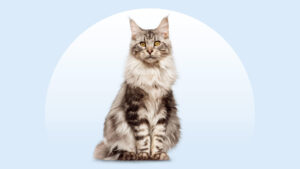


How to Care for a Savannah Cat
Savannah cats don’t require a lot of grooming, but they do need daily exercise, consistent training, and socialization to be their best selves.
Grooming
Diet
Exercise
Environment
Savannah Cat Health
The average Savannah cat lifespan is 12–15 years, but some can live into their 20s.
Maintaining routine dental care, keeping your cat at a healthy weight, and scheduling regular veterinary checkups, including following your vet’s guidance on preventive care and vaccinations, are the best ways to support a long, healthy life for your feline friend.
Even though Savannahs are a relatively healthy breed, they may experience health conditions, including:
- Pyruvate kinase deficiency (PK): A genetic disease that may cause anemia and other blood-related issues. To prevent passing this condition down, responsible Savannah cat breeders should always test their breeding cats for the PK gene. When looking for a kitten, ensure the breeder provides medical testing documentation confirming the parents are clear of the deficiency.
- Progressive retinal atrophy (PRA): This is a genetic eye disease that can lead to partial or total vision loss. To reduce the chance of passing on PRA, responsible breeders test their breeding cats for the PRA gene.
- Hypertrophic cardiomyopathy (HCM): HCM in cats occurs when the heart muscle walls thicken abnormally, which can lead to blood clots, heart failure, and death. Genetic testing for Savannah cats is not yet available.
- Dental disease: Like all cats, Savannah cats can develop dental disease. To help prevent it, start brushing your cat’s teeth at home while they’re young and schedule regular dental checkups with your veterinarian. When needed, your vet may recommend a professional dental cleaning under anesthesia.
- Obesity: Savannahs are no couch potatoes, but they still require intentional care to stay fit. To maintain a healthy weight, these hybrid cats need a combination of interactive play, daily opportunities for high-energy exercise, and carefully portioned meals.
Savannah Cat History
According to the International Cat Association (TICA), the first Savannah cat was born on April 7, 1986. The kitten, named Savannah, was the result of a cross between a wild African Serval and a domestic Siamese. Other domestic cats used to develop the Savannah breed include the Oriental Shorthair, Egyptian Mau, and domestic shorthair.
The breed gained official recognition and was registered with TICA in 2001. Still today, however, the Cat Fanciers’ Association does not recognize the Savannah cat as a registered breed. This is partly because Savannah cat breeders have not applied for registration, Keiger says, but also due to the CFA’s stance on hybrid cat breeding.
“CFA does not condone the cross-breeding of wild to domestic cats,” Keiger says. “It can be very dangerous or even deadly to the domestic cat being bred.”
While the Bengal cat—a hybrid cross between an Asian Leopard Cat and a domestic cat—is registered with the CFA, Keiger says they only recognize cats from the F6 generation and beyond, as “the cat should be far enough removed [from their wild ancestors] that problematic behaviors are much less apt to be present,” she says.