Topical Flea Treatment for Dogs: What It Is, How To Apply It, and More



Photo by Tatomm/iStock/Getty Images Plus
Fleas are pesky little parasites. Not only can they make your pup uncomfortable (and you, if your house gets infested), but they can also transmit diseases like tapeworm and typhus and cause other conditions like dermatitis and anemia. That’s why regular flea prevention for dogs is a must.
One type of flea preventive is topical flea treatment, but is it right for your pet? We talked to two veterinarians to provide expert insight on topical flea treatment for dogs.
Key Takeaways
- Most topical treatments last about 30 days and require regular reapplication.
- Apply treatment directly on the skin between shoulder blades, avoiding baths 48 hours before and after.
- Consult your vet to choose the best topical flea treatment for your dog's needs.
What Is Topical Flea Treatment for Dogs?
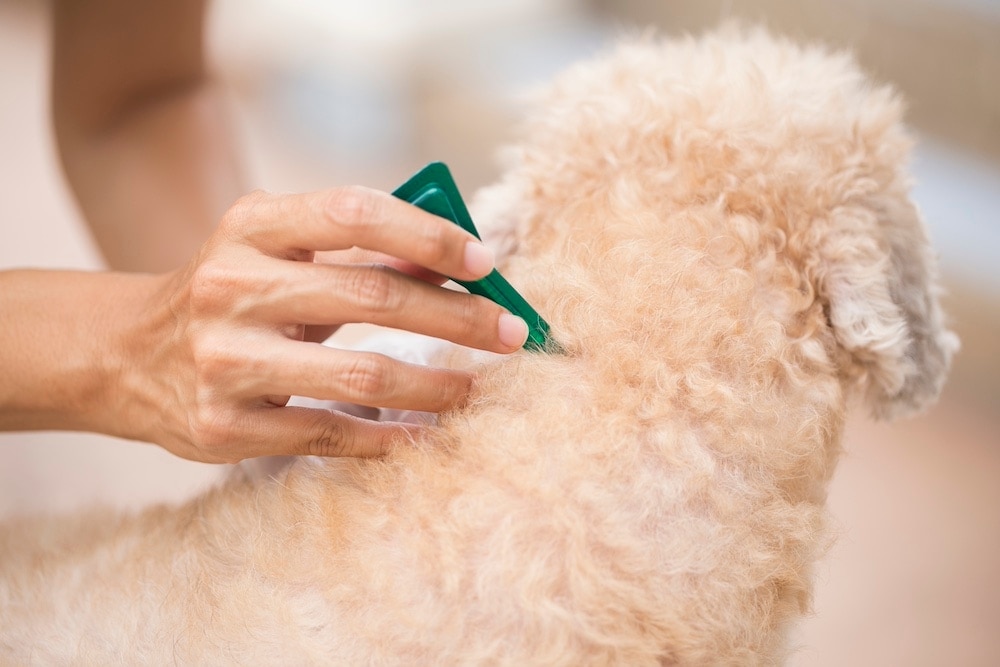
Tatomm/iStock/Getty Images Plus
There are three types of flea treatment and prevention: topical, oral, and collars.
Often called “spot-on treatments,” topical flea medicine for dogs is a liquid that you apply directly to your dog’s skin.
These treatments come packaged in individual doses that are applied by squeezing the liquid through an applicator onto your pet’s skin, usually between the shoulders. Larger dogs may need larger doses that are applied along the length of the back.
How Do Topical Flea Treatments Work?
Topical flea and tick treatments for dogs work by depositing parasite-killing medication into your dog’s sebaceous glands, which are located in the skin and secrete sebum, an oily substance that moisturizes and protects your dog’s coat.
After the treatment is applied to your dog’s skin, the active ingredients get absorbed and are then secreted with the sebum, effectively covering your dog’s coat all over.
When fleas encounter these ingredients, they attack the fleas’ nervous system, causing paralysis and eventually death, according to Wayne M. Johnson, VMD, founder of Birdneck Animal Hospital in Virginia Beach, Virginia.
Some topical flea treatments contain an insect growth regulator (IGR), which not only prevents flea eggs from hatching and growing into adult fleas but also helps prevent new infestations.
What Are the Active Ingredients in Topical Flea Treatment?
The active ingredients in a topical treatment for fleas on dogs can vary. Some have only one ingredient, while others have a combination.
While all ingredients have the same end goal—to kill the fleas—they work a bit differently.
Here are the most common active ingredients in topical flea treatments, and what they do:
- Dinotefuran and selamectin: These both work by paralyzing the nervous system, ultimately killing the fleas.
- Fluralaner: Fluralaner is an anti-parasitic drug that inhibits and overexcites the nervous system in fleas. It causes paralysis in fleas, then death.
- Fipronil: Fipronil works similarly to fluralaner. It keeps the nervous system (and muscles) in an overexcited and active state, causing paralysis and death in fleas.
- Imidacloprid: Imidacloprid mimics nicotine, which is toxic to fleas. It inhibits their central nervous system.
- Moxidectin: While Moxidectin doesn’t kill fleas on its own, it targets intestinal parasites like hookworms, roundworms, and whipworms, and is often combined with imidacloprid to provide comprehensive anti-parasitic coverage.
- Permethrin: Permethrin blocks the nervous system, causing muscle spasms, paralysis, and death in fleas.
- Pyriproxyfen: Pyriproxyfen is an insect growth regulator that mimics a natural hormone in fleas that prevents their growth. This is used to kill flea eggs, larvae, and young adult fleas.
- (S)-methoprene: (S)-methoprene is an insect growth regulator that prevents eggs and larvae from maturing—so if a flea lays eggs, they won’t hatch.
How Long Do Topical Flea Treatments Last on Dogs?
Most topical flea treatments last about one month on dogs. Some may last up to 12 weeks.
When choosing a treatment, double-check the length of protection so you can be prepared to administer future treatments when it’s time.
To keep your dog adequately protected, you’ll need to reapply when the treatment is no longer active—about 30 days, in most cases.
For effectiveness and safety, it’s also important you choose the right dose. Doses are determined by your pet’s weight, and the package will clearly state the weight range. If you’re not sure of your pet’s weight, or which dose to choose, ask your veterinarian.
Which Dogs Benefit Most From Topical Flea Treatments?
All dogs can benefit from topical flea treatments, but Dr. Johnson says there are some pups it’s particularly helpful for, including:
- Dogs who have a sensitive stomach or allergies
- Dogs who tend to have negative reactions to oral meds (some dogs can’t tolerate ingesting chemicals)
- Picky eaters who won’t reliably take chewable medications
- Adventurous dogs who spend a lot of time outdoors (topicals can add a layer of protection by repelling fleas, ticks, and mosquitoes even before they bite, says Dr. Johnson)
The Best Topical Flea Prevention for Dogs
The best topical flea prevention for your unique dog is best determined by your own veterinarian.
Recommended Products
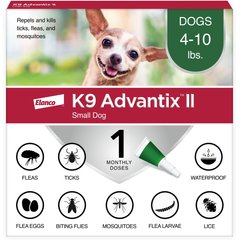
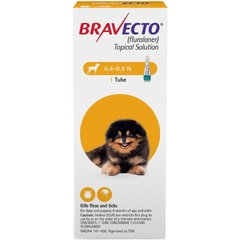
Kwane Stewart, DVM, veterinarian and co-founder of Project Street Vet in Encinitas, California, typically recommends Revolution or Bravecto if flea prevention is the main goal.
These topicals have active ingredients that target fleas. Bravecto is also one of the longest-lasting options, remaining effective for up to 12 weeks.
Recommended Products
When narrowing down your options, it’s best to get a recommendation from your vet. They can consider efficacy as well as your dog’s individual needs and situation.
Here are some of the most common topical flea treatments for dogs and how they stack up to each other.
| Product Name | Minimum Dog Age | Frequency | Active Ingredient(s) | Protects Against |
|---|---|---|---|---|
| Advantage II ($50, four doses–$70, six doses) | 7 weeks | Monthly | Imidacloprid, pyriproxyfen | Fleas, lice |
| Advantage Multi ($128, six doses–$260, 12 doses) | 7 weeks | Monthly | Imidacloprid, moxidectin | Fleas, roundworms, hookworms, heartworms, whipworms, sarcoptic mange, microfilaria |
| Bravecto ($63, one dose–$126, two doses) | 6 months | 12 weeks | Fluralaner | Fleas, ticks |
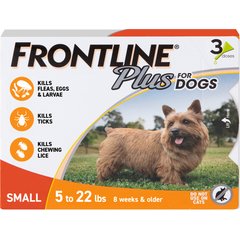
| Frontline Plus ($40, three doses–$79, six doses) | 8 weeks | Monthly | Fipronil, (S) methoprene | Fleas, ticks |
| K9 Advantix II ($58, four doses–$80, six doses) | 7 weeks | Monthly | Imidacloprid, permethrin, pyriproxyfen | Fleas, ticks, biting flies, mosquitoes, lice |
| OnGuard Plus ($21, three doses–$32, six doses) | 8 weeks | Monthly | Fipronil, (S) methoprene | Fleas, ticks, lice |
| PetArmor Plus ($21, three doses–$40, six doses) | 8 weeks | Monthly | Fipronil, (S) methoprene | Fleas, ticks, lice |
| PetPrevea Plus ($20, three doses–$34, six doses) | 8 weeks | Monthly | Fipronil, (S) methoprene | Fleas, ticks, lice |
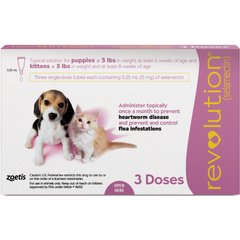
| Revolution ($87, three doses–$154, six doses) | 6 weeks | Monthly | Selamectin | Fleas, heartworm, ear mites |
| Vectra 3D ($44, three doses–$100, six doses) | 8 weeks | Monthly | Dinotefuran, pyriproxyfen, permethrin | Fleas, ticks, mosquitoes, lice, mites, flies |
How To Apply Topical Flea Treatment to Dogs
tatomm/Adobe Stock
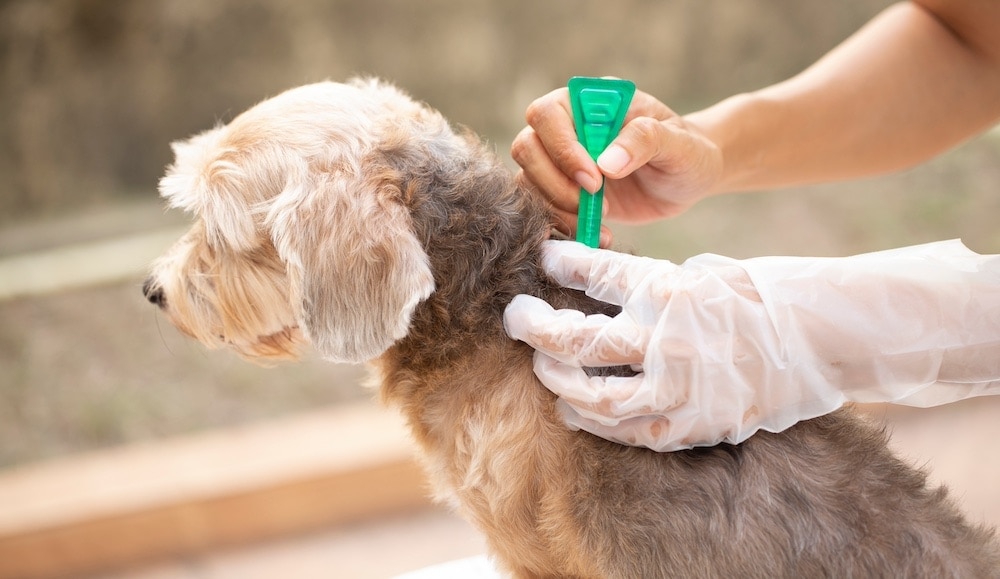
Generally, the steps for applying topical flea treatment are the same across the board. There might be slight differences on where to apply it—some recommend only between the shoulder blades, while others recommend applying in a line up your dog’s back.
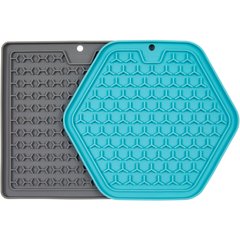
The hardest part is often getting your dog to stay in place long enough to get it on properly. It can be helpful to set up a lick mat to keep your pet still while keeping them occupied.
Recommended Product
You should always follow the directions on the flea and tick product package and consult with your veterinarian if you have any questions. That said, the process typically looks something like this:
- Step 1: Make sure your dog is calm and comfortable and in a room without distractions or other pets. Set up a lick mat if needed.
- Step 2: Part your dog’s fur between the shoulder blades so the skin is exposed.
- Step 3: Place the applicator tube vertically against your dog’s skin. Squeeze the tube to get the medication out, applying directly to the skin (not the fur) between the shoulder blades.
- Step 4: If directed, apply alongyour dog’s back, parting the fur and exposing the skin as you go. Continue until all the medication in one vial is used.
- Step 5: Monitor your dog for a couple of hours to make sure they don’t rub the product off before it dries.
- Step 6: Allow the medication to dry completely.
After the treatment is applied, do your best to keep your dog away from other pets in the house until it fully dries (this can take up to 24 hours).
This is especially important if you have cats. Some topical flea treatments for dogs are toxic to feline friends, and you don’t want any to rub off on them or otherwise be ingested. A cone collar or a crate may limit rubbing behavior.
Recommended Products


FAQs About Topical Flea Treatments for Dogs
Can you combine oral and topical flea treatments for dogs?
Do not combine oral and topical flea treatments for dogs unless directed by your veterinarian. Overloading your dog with different medications could lead to toxicity, says Dr. Johnson. If you suspect that one treatment alone isn’t doing the job, consult with your vet.
What’s the most effective topical flea treatment for dogs?
The most effective topical flea and tick prevention for dogs depends on your dog’s needs. Work with your vet to find the most effective flea treatment for your pet.
Should I bathe my dog before applying topical flea treatment?
Plan to bathe your dog 24–48 hours before applying the medication and wait two days afterward before giving your dog a bath post-treatment.
Dr. Johnson says clean skin absorbs the treatment better; however, you don’t want to bathe your dog right before applying as this can strip your pup’s skin of its natural oils.
Does it matter where you put flea treatment on a dog?
Yes, the placement of topical flea treatment on a dog is vital for effectiveness. Apply it directly on the skin between the shoulder blades, where your dog can’t lick it off.
For larger dogs, spreading it along the back as instructed by the product is important for full-body coverage, says Dr. Stewart.
Attributions