The Unique Caique

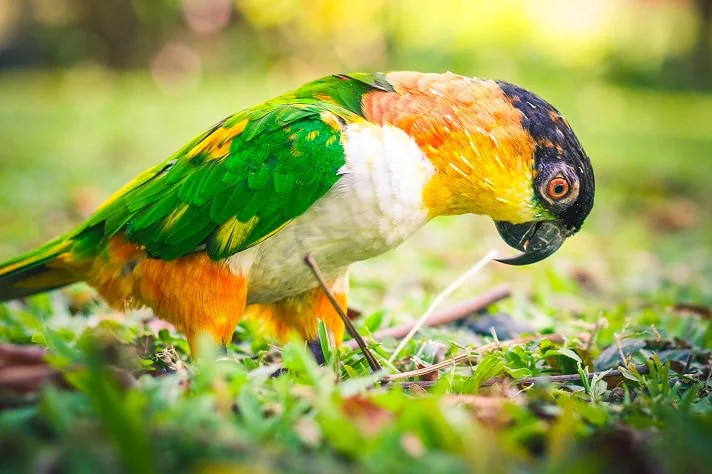
Photo by Chewy
You saw one at a pet store and were immediately charmed by the non-stop antics of this colorful, 9-inch, hopping bird—a jovial gymnast with charisma to spare, and the only parrot with a white belly.
Now you wonder: What would it be like to live with such a bundle of energy? We spoke to breeders, behaviorists, and pet parents to gather everything you need to know about caring for a caique.
Key Takeaways
- Caiques are long-lived, highly social parrots that require years of commitment and consistent daily human interaction.
- Their playful, energetic, and intelligent personalities make them charming companions who can learn tricks, mimic sounds, and even talk.
- Proper socialization, gentle guidance, and consistent training are essential to prevent behavioral problems in caiques.
- Caiques need spacious cages, plenty of toys, supervised time outside their cages—plus time for independent play and quiet retreats.
- Their high energy, strong personality, and need for interaction make them better suited to experienced bird keepers
1. They’re Long-Lived
Caiques live anywhere from 27 to 40 years or more, so you’ll be sharing your life with them for quite some time. Be prepared to spend many hours a week interacting with your pet caique.
“Caiques are a high-maintenance bird. They need a tremendous amount of human interaction to stay tame,” continued Sally Blanchard, avian behaviorist and pet parent to Spikey LeBec, a black-headed caique.
If you work all day, lots of toys will help occupy your pet bird, but nothing takes the place of focused attention to keep a caique tame and happy.
2. They’re Very Social
“Caiques are very outgoing and social,” said Tracy Day of Maryland, a pet parent to Pooka, a black-headed caique.
“What I love so much about caiques is that they’re so full of themselves,” said Blanchard. “They snort through their nostrils when they try to show what hot stuff they are. They strut and snort.”
3. They Need To Be Socialized
A caique’s need for interaction depends on how they were socialized as a baby. Caique breeder Gloria Balaban of Florida believes in early socialization. She doesn’t sell unweaned babies, believing that they need to learn how to be birds before they can interact with humans.
Caiques can be strong biters, but proper socialization should eliminate any problems. “Those that weren’t well socialized will have behavioral problems that might ruin their pet potential,” said caique breeder Veta Holloway of South Carolina. If biting does occur, it can be due to fear.
Caiques pick up on negative emotions. If there wasn’t a stimulus that may have scared your bird, were you scared or upset? Blanchard believes that a lot of caique aggression (lunge biting) comes from being excited.
If your caique is wound up or excited, pet it slowly. Slow it down by slowing down your own energy, she advises.
4. They Can Be “Beaky”
Caiques like being handled, Balaban considers caiques a very “beaky” species. “They’ll use their beak to explore you, but don’t encourage rough play.” Activities like “beak wrestling” or tug-o-war should be avoided.
Blanchard guesses that chewing on you is their way of reciprocating your handling. Chewing on their humans is normal and shows affection. Despite this behavior, they’re not known to be big cuddlers.
Never confuse chewing with nipping, she warns. If a bird is actually nipping, Blanchard suggests that you give them something else to nip besides your finger.
5. They Can Be Vocal
Holloway warns all potential caique parents: “Caiques can be noisy if they’re not getting their way — like a child that pouts. They’ll scream until they get their way.”
“When caiques are good, they’re very, very good. When they’re bad, they’re horrid,” said Blanchard. Their scream is a repetitive nagging sound that grates on the nerves because there’s no variation to it, as with many other birds.
But noise really is relative and dependent upon the bird. She believes you can usually avoid most screaming by keeping your caique from getting bored or by giving them focused attention when they give out two or three contact calls.
6. They Can Learn To Talk
Caiques are not at the talking level of an Amazon parrot or an African grey, but they do talk. Caiques love mimicking sounds, whistling songs, or imitating the beep of a fax machine, microwave, squeaky door, or the meow of a cat.
“Every pet caique I know says at least a couple of words. They talk in a little squeaky Minnie Mouse or gruff Donald Duck-type voice,” reports Balaban. “Strangers may not be able to understand what your bird says, but you will.”
Spikey LeBec says about 20 phrases and loves to whistle off key, but Blanchard notes most caiques aren’t able to enunciate very well. Still, with training, you can probably teach your caique to say a few words.
7. They’re Playful
“Most caiques think of life as an amusement park ride. They’re into the adventure,” notes Blanchard. Days concurs: “I think they view everyone and everything as a potential playmate. I think that caiques have two mottoes: ‘No fear!’ and ‘Life is short, play with as many toys as you can!'”
This same sense of adventure has a plus side, because it makes caiques good candidates for traveling, either by car or plane.
“Caiques are very independent and playful birds that will usually entertain themselves. However, if given a choice between playing by themselves or being with their favorite human, they will pick the human,” said Day.
8. They’re Highly Intelligent
Caiques are very intelligent and have natural behaviors that help them learn tricks quickly. Blanchard uses Spike’s natural hopping behavior to pretend he’s a wind-up toy. She winds him up, sets him on a table and he hops away.
She also taught Spike to dance to music by playing off his natural bobbing behavior. She started whistling to his bobbing and gradually got him to bob to her whistling, too. Spike learned to roll over and play dead when “shot” in only a half-hour, and to somersault into Blanchard’s hand within five minutes.
Balaban believes most baby caiques can be taught to step-up in five to 10 minutes. Many caiques are even potty trained. The only limitation seems to be the time and type of training the pet parent is willing to do.
9. They’re Adaptable
Caiques are very adaptable when it comes to temperature or the need for quiet/noise. They generally won’t mind a lot of commotion in a household, either.
“If you’re comfortable, they’re comfortable,” said Balaban. However, when you first acquire your caique, Holloway believes you should acclimate it if it’s coming from a situation that is much warmer or cooler than your own.
You should also provide a hideaway in their cage for those times that they wish to be alone. “Caiques are either 100 percent on or 100 percent off. When they’re off, they want to retreat,” said Blanchard.
10. They Need a Big Cage
Give your caique lots of cage space. Our panel of experts agreed that bigger is better. “I think birds need cages sized according to energy level,” said Blanchard. “Caiques need a lot of space.”
Her caique, Spikey LeBec, hangs out in a 36 by 24 by 48-inch cage with 3/4-inch bar spacing. She believes all parrots need time spent outdoors (but in their cage) to bask in the natural sunlight. Height is equally important as width for these birds, because they enjoy swinging on toys and playing Tarzan.
Dometop or playtop can be your own choice, though Day recommends a dometop, “A playtop is nice, but a dometop gives you more usable room to hang toys for the bird to play.”
Caiques also need plenty of time outside their bird cages, though their curiosity can get them into trouble, so they should always be supervised.
11. They Love To Surf
Another trait unique to caiques is their joy of surfing. In the wild, caiques are an upper tree canopy bird. There are lots of flat leaf surfaces in the upper canopy, and caiques love to leaf bathe.
Domestic birds satisfy this need by surfing. They spread the feathers on their cheek and thighs and rub their whole body on any nappy or textured surface. It’s not a sexual behavior, notes Blanchard.
12. They Love Toys
Toys are another reason you need a big cage. Toys are a must, and the caique’s nonstop energy spurs them to play with all of their toys every day, so rotate toys often to keep their interest. The more bird toys, the better.
They particularly enjoy foot toys, those with bright colors, and those that move or make noise. Providing them with something to hang from or swing on brings out the Tarzan in them.
“By the time you put all the toys caiques require in a cage, there’s no room for a bird if the cage is too small,” notes Holloway.
13. They Can Be Kept in Pairs
For a bird kept alone, human interaction is doubly important—and only common sense. The more intelligent the bird, the more interaction it requires, and caiques are very intelligent, according to Balaban.
She believes caique pairs are twice the fun: “Caiques are one of the few birds that you can maintain a human/pet relationship with even if paired.”
Holloway agrees. “This is the only bird that I will tell a prospective pet owner it’s okay to have two in the same cage, as long as the owner interacts with both caiques.”
However, Balaban warns that during breeding the caique’s desire to interact with humans drops dramatically. After breeding, they should be back to their lovable selves. This quality adds to the caiques’ uniqueness because most other birds are less tame and forget about their humans once they’re paired.
Keeping two caiques definitely increases the pet parent’s workload and time commitment. And of course, if you pair caiques, it should be with the same sex, unless you have plans for breeding them.
14. They Love To Eat
Caiques love to eat. “They’ll sell their soul for a grape,” joked Balaban. Reports of a finicky caique are very rare and are usually due to improper weaning.
Pet parents must ensure that caiques get a balanced diet. They enjoy variety, but their high energy demands a bit more fruit in their diet than most parrots usually get. Vegetables high in vitamin A are another must.
These, in addition to a seed and pelleted diet, should keep your caique healthy and happy. But be warned! Caiques are very food possessive.
“The only time I expect Spike to bite me is when he’s eating a favorite food and I try to pick him up,” shared Blanchard. This possessiveness might cause problems if you house two caiques together, in which case Blanchard recommends giving each caique their own food bowl.
15. They’re Best for Experienced Bird Keepers
Caiques are not a parrot for someone with little or no bird experience.”You must always gently guide their behavior. If people don’t set rules and provide nurturing guidance, they can get into serious problems with caiques right away,” said Blanchard.
Blanchard warns of another reason to be wary of caiques as a first-time bird keeper: “Aggression is met with aggression, so be gentle. Praise good behavior and ignore bad. Caiques do not forget or forgive, and you must constantly earn their trust.”
“The more educated an owner is about how to handle a bird, the better the bird. Guide their behavior, do not punish,” said Blanchard.
Feature Image: Via Nik Voon/Flickr
FAQs About Caiques
How long do caiques live?
Caiques typically live 27 to 40 years or longer with proper care, making them a long-term commitment for prospective pet parents.
Are caiques good pets for first-time bird owners?
Caiques are generally better suited to experienced bird keepers because of their high energy, strong personalities, and need for consistent training and socialization.
Are caiques affectionate and cuddly?
Caiques are affectionate, social birds that enjoy interacting with their favorite people, although they tend to be more playful than cuddly.
Can caiques learn to talk?
Yes, caiques can learn a few words and phrases, but they are better known for mimicking sounds, whistling, and imitating noises around the house.
Are caiques noisy birds?
Caiques can be quite vocal, especially when bored or seeking attention, although their noise levels vary from bird to bird.
Do caiques need a lot of attention?
Yes, caiques need substantial daily interaction and mental stimulation to remain tame, happy, and well-adjusted. Toys are one way to keep them stimulated and engaged.
Can caiques be kept in pairs?
Yes, caiques can be kept in pairs while maintaining relationships with their human family, provided both birds receive regular individual attention and interaction with their pet parent.
Why do caiques bite or chew on their pet parent?
Caiques often use their beaks to explore and interact with people, but rough play should be discouraged, and biting should be addressed through gentle, consistent training.
What size cage does a caique need?
Caiques need a spacious cage with plenty of room for climbing, swinging, and playing, as well as space for their many toys. A larger cage is generally better, and a good minimum size is 36 by 24 by 48-inches with 3/4-inch bar spacing
What toys do caiques enjoy most?
Caiques enjoy colorful toys, foot toys, swings, climbing toys, and objects that move or make noise, making regular toy rotation important for keeping them entertained.
Can caiques be trained to do tricks?
Yes, caiques are intelligent birds that can quickly learn tricks such as dancing, hopping, rolling over, and stepping up with positive reinforcement and consistent practice.
Can caiques be kept in pairs?
Yes! Caiques can be kept in pairs and are one of the parrot species that can maintain a strong relationship with their human family members even when housed with another caique. Consistent interaction with each of your pet caiques will ensure they won’t shut you out of their flock.
Are caiques high-maintenance pets?
Yes, caiques require considerable time, attention, training, toys, enrichment, and daily care, making them a time commitment as well as a highly entertaining companion pet for the right owner.
Why do caiques love surfing on blankets and clothing?
Caiques enjoy rubbing their bodies against soft or textured surfaces, a behavior known as surfing that mimics their natural leaf-bathing behavior in the wild.
What do caiques eat?
Like other parrots, caiques need a balanced diet consisting of quality pellets, appropriate seeds, fresh fruits, and vegetables—particularly those rich in vitamin A.
Attributions