Scottish Fold
Updated April 30, 2026
Scottish Fold
Updated April 30, 2026
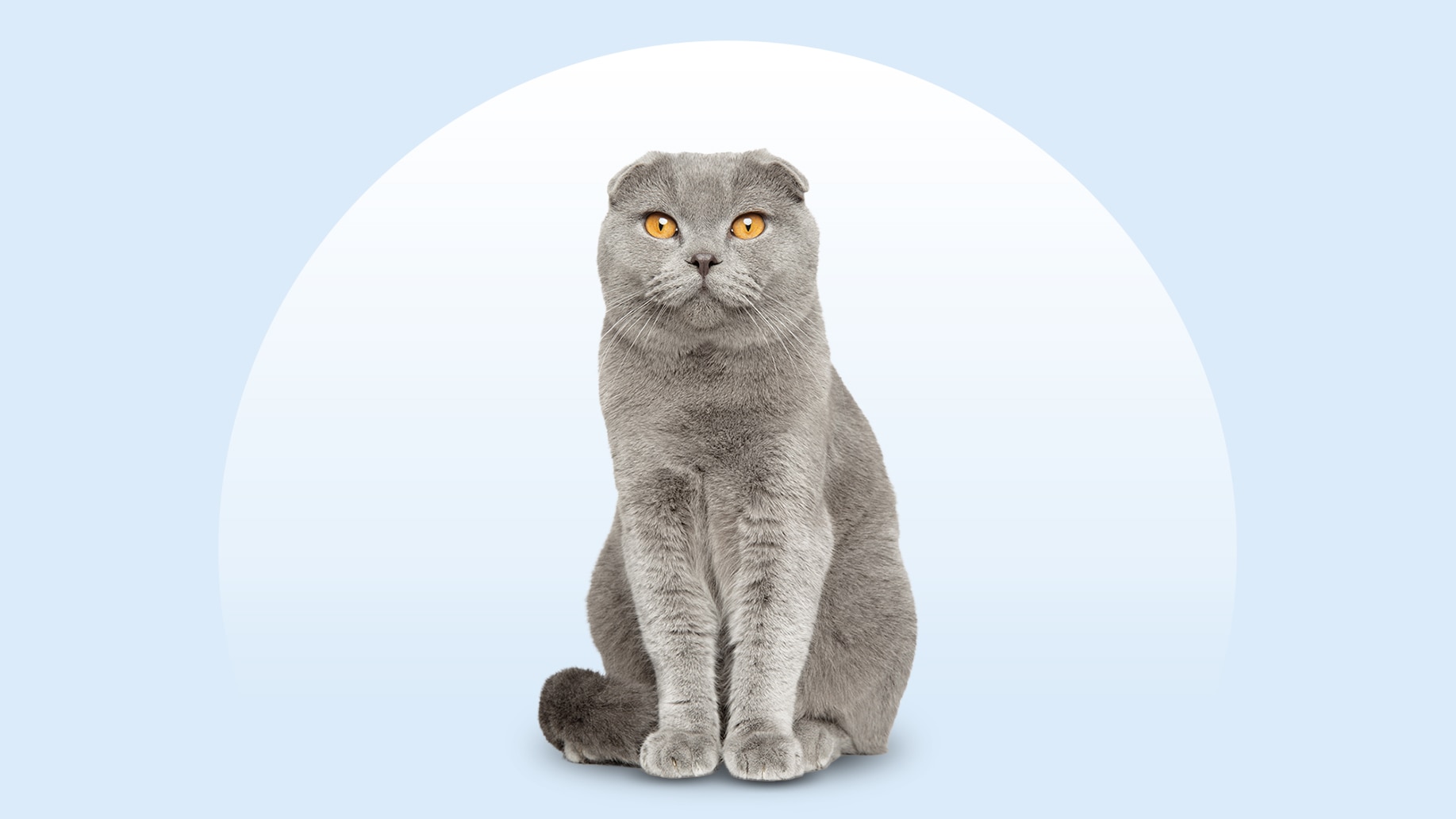
Scottish Fold cats are recognizable by their folded ears, big eyes, and round cheeks, but the best part of the breed is that they’re easy to love and, with proper care and ethical breeding practices, you’ll enjoy many years with your furry shadow.
Devoted, Inquisitive, Easygoing
7–10 pounds
11–16 years
The ears might be what draws you in, but the Scottish Fold is beloved for their sweet, gentle personality. Scottish Fold cats take a particular interest in people, making them interactive and easy to train.
Because of their good nature and adaptability, a Scottish Fold can be a great pet for just about anyone seeking a loyal, fun cat companion.
However, there are some health considerations linked to the breed’s characteristic ears. Always work with an ethical breeder to ensure your Scottish Fold kitten is as healthy as possible.
Recommended Products


Scottish Fold Characteristics
Scottish Fold Appearance
Scottish Fold cats have soft, plush coats, round features, and an almost kitten-like appearance that sticks around into adulthood. These cats tend to look more like plushies than athletes, but that doesn’t mean they should be overweight. Instead, these cats have a firm body, stout legs, and short necks.

- Ears
Scottish Fold ears are small, with rounded tips, set apart on either side of the head. Cats with folded ears carry a genetic mutation that causes their ears to fold forward and lie close to the head. Straight-eared Scottish Folds (those without the gene mutation, aka the Scottish Straight) have upright ears.
- Eyes
A Scottish Fold cat has large, round eyes that are often copper or gold. But depending on the color of their coat, these cats might also have green, blue, or hazel eyes.
- Nose
The nose is broad and short. The nose can be many different colors, including brown, black, pink, or fawn.
- Coat Length
Most Scottish Fold cats have a plush, dense, short coat covering the body. Some can have a “semi-long” coat.
- Coat Color
Scottish Fold cats can be any color or pattern.
- Tail
The tail is medium to long and often tapers to a rounded tip.
Scottish Fold Temperament
Far from aloof and independent, Scottish Folds are often friendly and affectionate cats.
“They tend to be people-oriented and form strong bonds with their families,” says Alena Anderson, a Scottish Fold breeder at Terra D’oro Santo Cattery. “From our experiences, they love to follow us from room to room just to be nearby, always observing and curious about what it is that we are doing.”
A Scottish Fold cat is happiest at your side (or in your lap). These cats are known for seeking out human affection and will welcome just about any opportunity to be pet or receive your attention.
Many Scottish Fold cats are talkative. Renee Sargent, a Scottish Fold breeder at East Coast Cat, credits this to the breed’s curious and interactive personality traits. She says this breed will communicate using a variety of sounds, including chortles, purrs, and meows.
Additionally, Anderson says the patient and tolerant personality of a Scottish Fold means these cats usually get along well with children and other pets. Of course, the key is to teach children to interact gently and respectfully with cats and other pets.
And when it comes to introducing your new Scottish Fold to other four-legged members of the family, make sure you take the time to introduce your pets and closely supervise them at first. Everyone should be properly socialized, too.
Related Breeds


How to Care for a Scottish Fold
Keeping with their easygoing nature, Scottish Fold cats aren’t fussy about many aspects of care. Their biggest demand is your time and attention.
Grooming
Diet
Exercise
Environment
Scottish Fold Health
Several serious genetic conditions can affect the Scottish Fold breed. Because of this, work only with reputable breeders to ensure that your cat is as healthy as possible.
- Osteochondrodysplasia (OCD): Also known as Scottish Fold disease, OCD is a genetic mutation that affects cartilage development. Cats with folded ears have at least one copy of the gene (the Fd gene), which can also lead to problems like misshapen toes, inflexible tails, and arthritis. Cats who inherit two copies of this gene develop even more serious cartilage and bone abnormalities. Always ask any prospective breeder for proof of genetic testing of both parents, and if you want all the joy that Scottish Folds can bring without the OCD, consider bringing home the breed’s sibling, the Scottish Straight.
- Polycystic kidney disease: PKD in cats results in cysts that affect the tissue of a cat’s kidneys. It’s most common in Persian cats and in cats with Persian genes, including the Scottish Fold.
- Hypertrophic cardiomyopathy (HCM): Hypertrophic cardiomyopathy (HCM) is the most common heart condition in cats, which causes the muscle wall of the heart to thicken and can lead to heart failure.
Scottish Fold History
All Scottish Fold cats can trace their ancestry back to a single barn cat found in Scotland in 1961.
According to the International Cat Association (TICA), a man named William Ross found a white longhaired cat with folded ears. He named the cat Susi. Her descendants were later bred with British Shorthairs, American Shorthairs, Persians, and others. While not every kitten retained the folded ears that first made Susi famous, this trait was passed on to many in her lineage.
Continued selective breeding has created the Scottish Fold cat breed. “It is important to never breed a Scottish Fold with a Scottish Fold, as it will have an effect on their offspring,” Anderson says. The breed standard allows the Scottish Fold to be bred to a Scottish Straight, American Shorthair, British Shorthair, or British Longhair cat.