Siberian Cat
Updated March 26, 2026
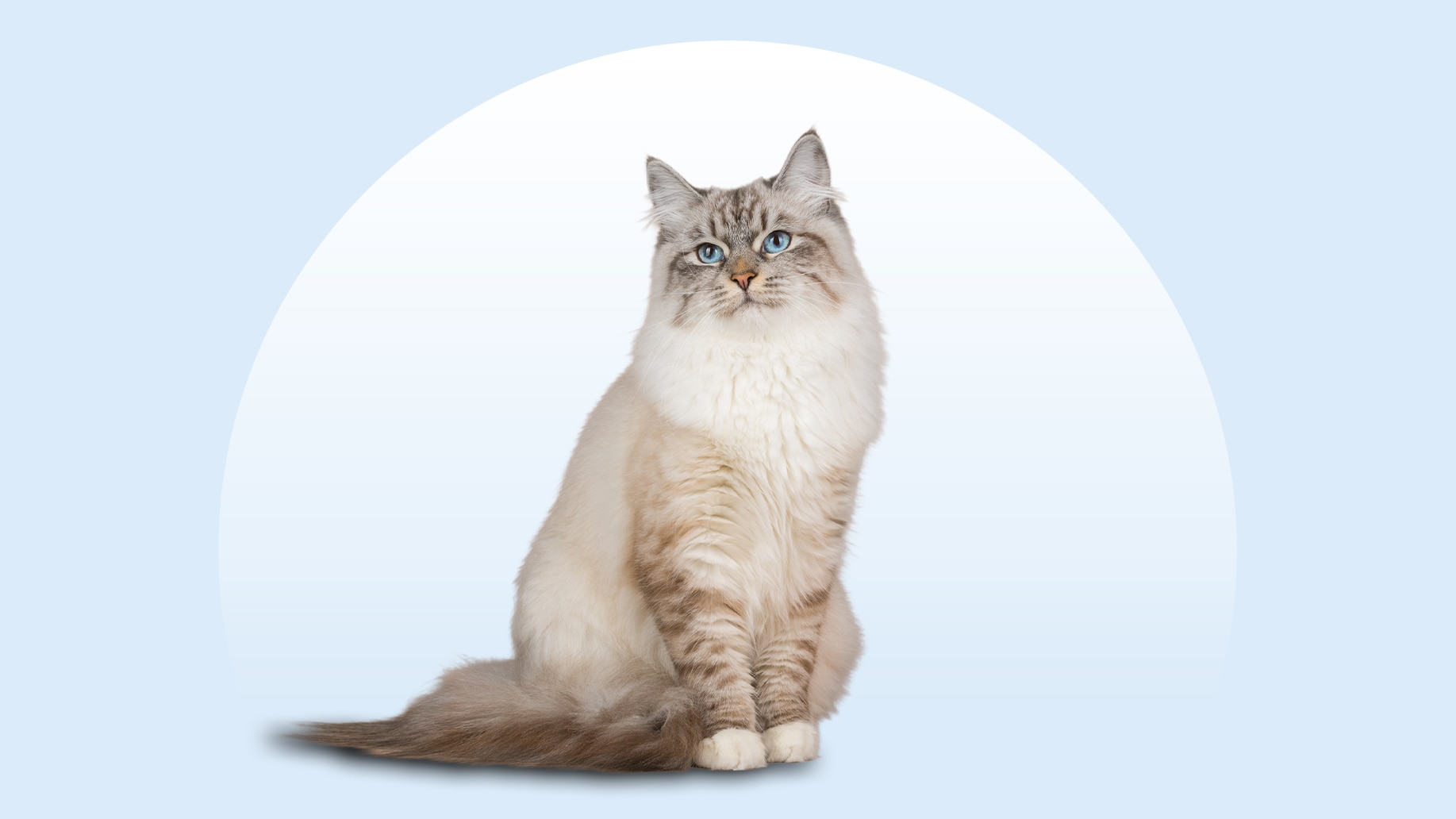
Siberian Cat
Updated March 26, 2026
The Siberian cat is a loyal, affectionate, and surprisingly allergen-friendly breed. They’re best suited for families or people who want a devoted companion who’ll follow them from room to room and join in on every conversation.
Chatty, Witty, Sociable
12–15 pounds
11–18 years
Living with a Siberian cat means accepting, early and completely, that privacy is a concept that no longer applies to you. Your space is their space. Your hand is their personal belly rub station. Your shower is their observation post. And your face? A perfectly acceptable napping spot.
If you’re smitten with the sociable Siberian but are tragically allergic to cats, we have good news: Siberians are considered hypoallergenic cats, thanks to naturally lower levels of Fel d 1, the protein found in cat saliva, urine, and dander that’s responsible for cat allergies.
And speaking of fur—oh, the fur. Thick, lush, and frankly a little dramatic, it perfectly suits a cat with this much personality.
So, cancel your plans and stay in for the night—this big, affectionate kitty wants your love and attention, and they want it now. In return, you’ll get a loyal, devoted companion who will follow you from room to room; supervise your every move; and never, ever let you have the last word.
Recommended Products



Siberian Cat Characteristics
Siberian Cat Appearance
Underneath all that triple-layered, water-resistant fur is a surprisingly solid, muscular cat. Built to survive the frozen terrain of their native Siberia, the Siberian cat is a medium-size breed.
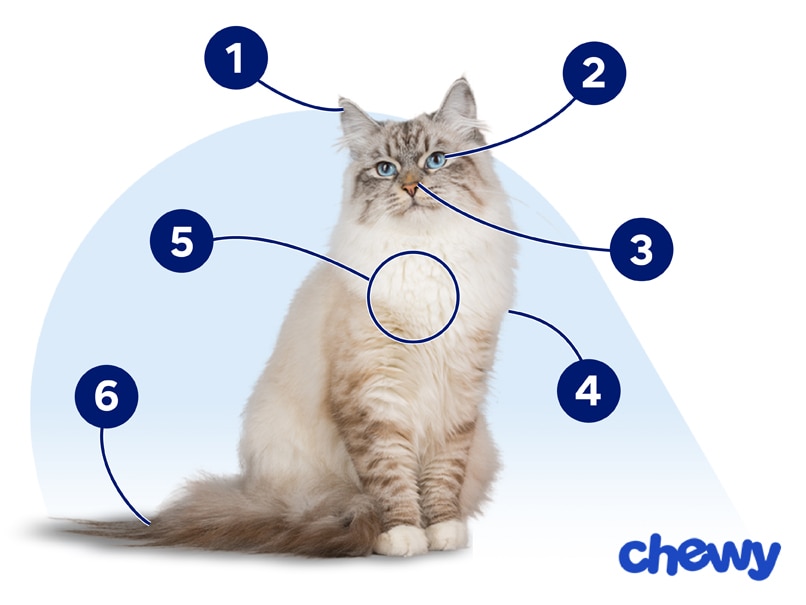
- Ears
Siberian cats have medium to large ears that are rounded at the tips, though long tufts of fur, called “ear tufts” or “lynx tips,” can make them appear pointed. Their ears may tilt slightly forward.
- Eyes
Siberians have large, mostly round eyes that angle just slightly upward at the outer corners. While white Siberian cats have blue eyes, Siberian cats of all other colors have eyes in shades of golden, green, or copper.
- Nose
Siberian cats have leathery noses that can be pink, chocolate brown, black, or gray, depending on their coat color.
- Coat Length
Siberians have a long, triple-layered coat: a soft undercoat, an insulating middle layer, and a long, oily, coarse outer layer of guard hairs that keep them dry and warm through brutal Siberian winters. The fur around the shoulders and lower chest is thick but slightly shorter, while around the neck it forms a dramatic mane called a frontal ruff.
- Coat Color
Siberian cats come in virtually every color—solid white, black, red, blue, silver, and more—and a wide variety of patterns including point, calico, tabby, tortoiseshell, and bicolor.
- Tail
A Siberian's bushy tail tapers slightly to a blunt tip and is a bit shorter than the length of their body.
Siberian Cat Temperament
Beneath that triple-layered, weatherproof coat and sturdy frame is a big softie. One look at a Siberian flopped on the couch—belly up, paws out, shamelessly asking for pets—and the stories of their ancestors stalking across the frozen tundra start to sound like a tall tale.
But it’s true: Wild origins and all, the Siberian cat personality is deeply affectionate and people-oriented. These cats thrive on companionship and want to be near you, with you, and ideally in conversation with you. This makes them an ideal family cat.
Not only will you never walk from room to room alone again, but chirps, trills, and soft vocalizations mean your Siberian will narrate the entire journey. They’re not loud cats, but they talk a lot—and they have opinions. Affection on their terms is part of the deal. Siberians are social and loving, but being scooped up or smothered with hugs isn’t always on their agenda.
That said, Siberians are gentle cats, making them a natural fit for families with children. Their friendly temperament means they generally welcome the company of other cats or dogs, too, provided introductions are done properly.
What Siberians struggle with is solitude. A Siberian left alone too long is an unhappy Siberian, and possibly a mischievous one. When you do have to leave them, expect a full welcome-home committee when you return.
Related Breeds


How to Care for a Siberian Cat
Siberian cats require all the essentials that come with any feline: scheduled mealtimes, daily playtime, and regular litter box maintenance. Where their care is a little more hands-on is the coat.
Siberians belong to an elite group of longhaired cat breeds—alongside Persians, Himalayans, Maine Coons, Ragdolls, and Norwegian Forest Cats—who require the most grooming, says master groomer Shawn Lioyryan of Cats in the City in Portland, Oregon.
To keep that impressive mane tangle- and mat-free, Lioyryan recommends building good grooming habits when your Siberian kitten is young. “Even if your cat tells you they do not like the process, work with them on a process that they do appreciate,” he says.
Grooming
Diet
Exercise
Environment
Siberian Cat Health
The average Siberian lifespan is 11–18 years. They’re generally considered a healthy breed, in part because of their unique genetic history and breed management.
Most purebred cats are established from a relatively small founding population. “From a health perspective, selective breeding inherently reduces genetic diversity within a population,” says Robert Grahn, Ph.D., associate director of services and test development at the UC Davis Veterinary Genetics Laboratory. In other words, the smaller the gene pool, the greater the likelihood of inherited health conditions.
However, Siberians are an exception. They’re a natural breed—one that developed in the wild rather than through deliberate human breeding—so they began with a broader genetic pool than most cat breeds.
And unlike many breeds whose registries closed once breed standards were established, Siberians from the former USSR can still be introduced into today’s breeding programs. This ongoing connection to the natural population maintains a level of genetic diversity that is genuinely rare among recognized breeds.
While this contributes to Siberians being one of the healthiest purebred cats, no cat is immune to all health conditions. Knowing what to watch for can help you catch early signs and take preventive steps.
Common health risks for Siberian cats include:
- Hypertrophic cardiomyopathy (HCM): This is the most common form of heart disease in cats. HCM causes the walls of the heart muscle to thicken abnormally, which can lead to blood clots, heart failure, and death. Because genetic testing is not currently available for Siberians, routine echocardiograms are the best way to screen for and monitor the condition.
- Obesity: Carrying extra weight can cause joint pain, limit mobility, and significantly shorten your cat’s lifespan. The best way to keep your Siberian at a healthy weight is by feeding appropriately portioned, scheduled meals.
Siberian Cat History
That triple-layered, water-resistant coat isn’t just for looks. The Siberian is a native cat of Siberia, the vast subarctic region spanning central and eastern Russia—and one of the coldest places on Earth. Yakutsk, one of Siberia’s major cities, regularly sees winter temperatures plunge to −43.6 F.
But this kitty wasn’t keeping warm in their human’s apartment. According to The International Cat Association, the earliest known reference to the Siberian dates to 1000 CE, meaning this breed has been navigating frozen forests and brutal winters long before it ever set paws in a living room.
Fast forward nearly 1,000 years, and the Siberian’s first recorded appearance at a cat show was in the 1870s, though the official breed standard wasn’t established until the 1980s. The breed made its way to the U.S. in 1990, and TICA accepted them into their New Breed program in 1992, granting championship status in 1996.
Despite the phenomenal leap from frozen tundra to living room couch, Siberians remain closely connected to their natural heritage. Unlike most purebred cat breeds, new individuals from the natural Siberian population can still be introduced into today’s breeding programs, helping maintain the rich genetic diversity that makes this breed one of the healthiest around.