Burmese Cat
Updated June 8, 2026
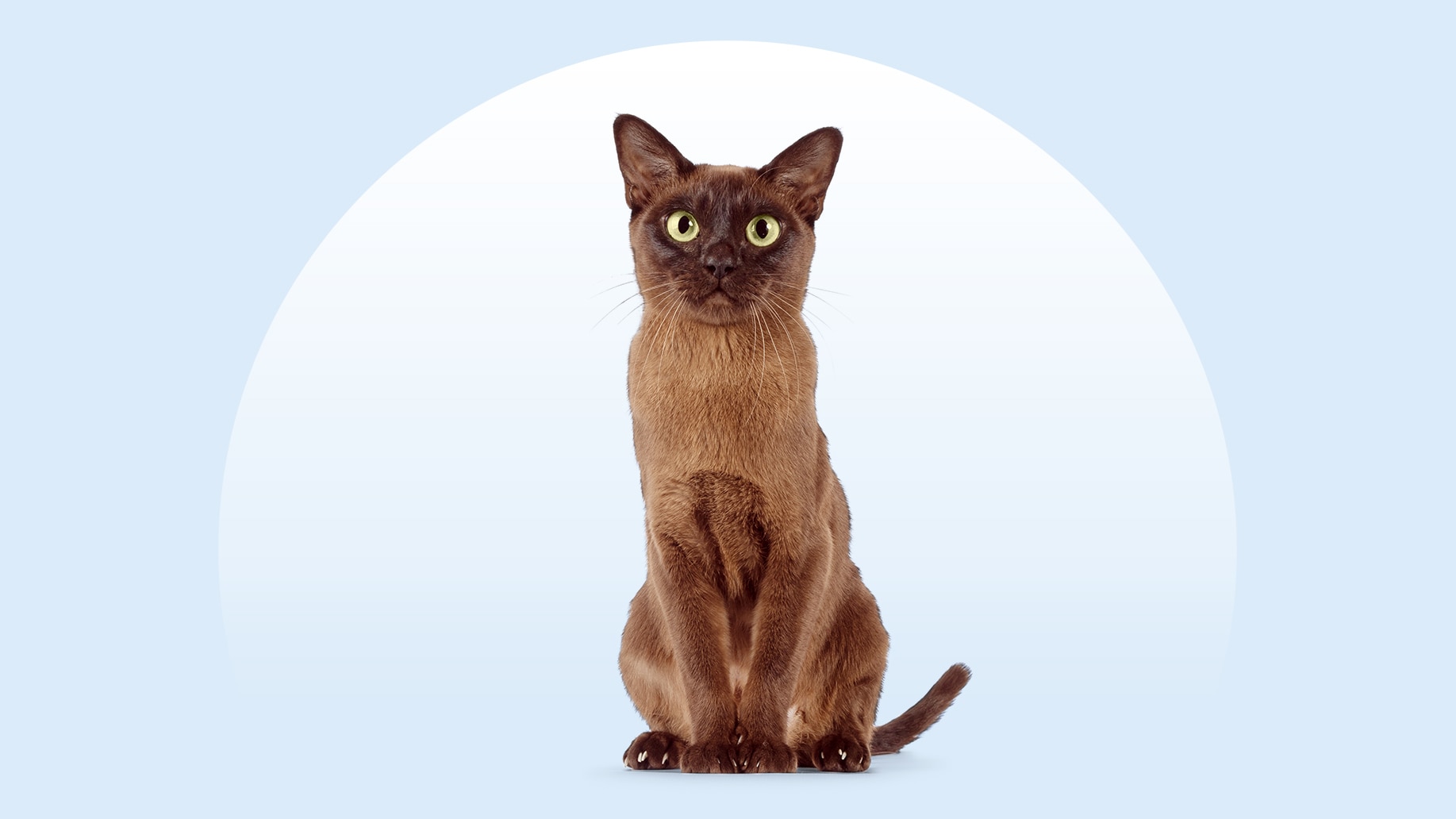
Burmese Cat
Updated June 8, 2026
What do you get when you mix the demeanor of a Golden Retriever with a golden-eyed feline? The Burmese cat. These playful kitties don’t mind public displays of affection: If you have an empty lap, a Burmese would like to call dibs.
Cuddle Companion, Attention-Lover, Playful Partner
Up to 12 pounds
9–13 years
Burmese cats are full of surprises. For starters, contrary to typical feline stereotypes, the breed is highly people-oriented and perfectly pleased to be picked up. In fact, they’re sometimes referred to as “Velcro cats” for this reason. And though Burmese are medium in size, they are heavier than they look and can weigh up to 12 pounds.
True to their name, Burmese cats do indeed trace their origins back to the Southeast Asian nation of Burma (now Myanmar). But with their doting demeanor, Burmese can feel at home just about anywhere they have a devoted human by their side.
Burmese Cat Characteristics
Burmese Cat Appearance
According to the Cat Fanciers Association (CFA), the ideal Burmese cat is medium-size with “substantial bone structure, good muscular development, and a surprising weight.”
From the tops of their rounded heads to the tips of their straight tails—and all the satin-like fur in between—Burmese are a beautiful breed to behold.
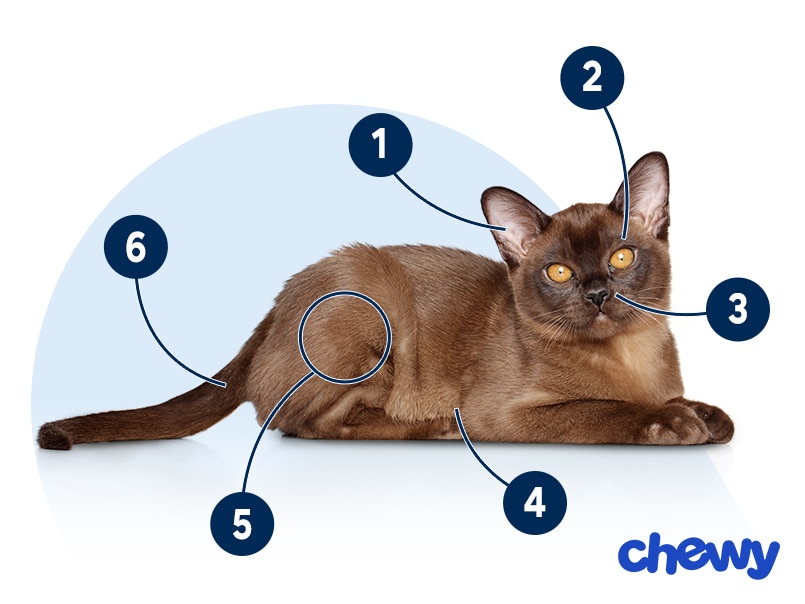
- Ears
Burmese ears are triangular but rounded at the tops. They also naturally tilt forward a bit, lending Burmese an alert appearance.Burmese cats have large, round eyes that range in color from yellow to gold.
- Eyes
Burmese cats have large, round eyes that range in color from yellow to gold.
- Nose
Burmese have short muzzles and noses that vary in color according to their coat. Those with sable and champagne coats have brown noses. Blue-coated cats have slate gray noses, and platinum coats have lavender-pink noses.
- Coat Length
Burmese have short, soft, and shiny coats that don’t shed much.
- Coat Color
Burmese can be sable, champagne, blue, or platinum.
- Tail
Burmese have straight tails that are medium in length.
Burmese Cat Temperament
A Burmese cat’s temperament is all about loving and being loved. Contrary to the stereotype of many cats as aloof and hyper-independent, Burmese generally don’t enjoy alone time. These friendly cats would prefer to stick by their human’s side—or, better yet, be in their arms. Burmese are happy to be handled.
Burmese are also happy to play with people of all ages, including small children, and are less likely to pick one special person they like the most. The International Cat Association (TICA) notes that Burmese tolerate the youngest family members with ease.
Burmese kittens are particularly playful, but adult cats enjoy playing games, too. And while soft meows and purrs are their default, Burmese are highly capable of getting your attention vocally if they need to.
Related Breeds



How to Care for a Burmese Cat
Burmese are fairly low-maintenance cats. They love being handled, and their fur needs little grooming to stay healthy. Pet parents will likely spend the most time simply providing companionship.
Considering how much hands-on attention Burmese desire, it’s a lucky break that they happen to be covered in soft, silky fur.
Grooming
Diet
Exercise
Environment
Burmese Cat Health
The average Burmese cat lifespan is 9–13 years, but they often live much longer. Like all breeds, they are predisposed to certain health conditions.
- Hypertrophic cardiomyopathy: Hypertrophic cardiomyopathy (HCM) is the most common form of heart disease in cats. Signs of HCM include appetite loss, heart murmur, arrhythmias, blood clots, heart failure, fluid in the lungs and abdomen, difficulty breathing, and lethargy. HCM can often be treated with medication, but other cats may need a regular thoracocentesis—a procedure that drains excess fluid around the lungs (pleural effusion) and/or in the abdomen—or even oxygen therapy.
- Diabetes mellitus: Diabetes in cats is a common endocrine disease. Cats with diabetes either can’t produce enough insulin (Type 1) or can’t use the insulin they produce (Type 2). In cats, Type 2 diabetes (aka insulin-resistant diabetes) is far more common. Signs of diabetes include increased thirst, increased frequency and volume of urination, accidents outside the litter box, weight loss, vomiting, and lethargy. There isn’t a cure for cat diabetes, but it can be managed with insulin injections and diet changes.
Burmese Cat History
The Burmese breed traces its beginnings back to a small female cat named Wong Mau, according to the breed club. A sailor brought Wong Mau from Burma to the United States in 1930 and gave her to Joseph Thompson, an American doctor in San Francisco. Believing that he had a new breed in his midst, Thompson hoped to reproduce her unique traits.
In 1932, Thompson bred Wong Mau with a seal point Siamese cat named Tai Mau. The dark brown kittens produced from continued breeding went on to become the foundation of the Burmese breed, and TICA notes that Wong Mau is now believed to have been a Siamese–Burmese hybrid.
The Burmese breed was officially recognized by TICA in June 1979.