Norwegian Forest Cat
Updated May 4, 2026
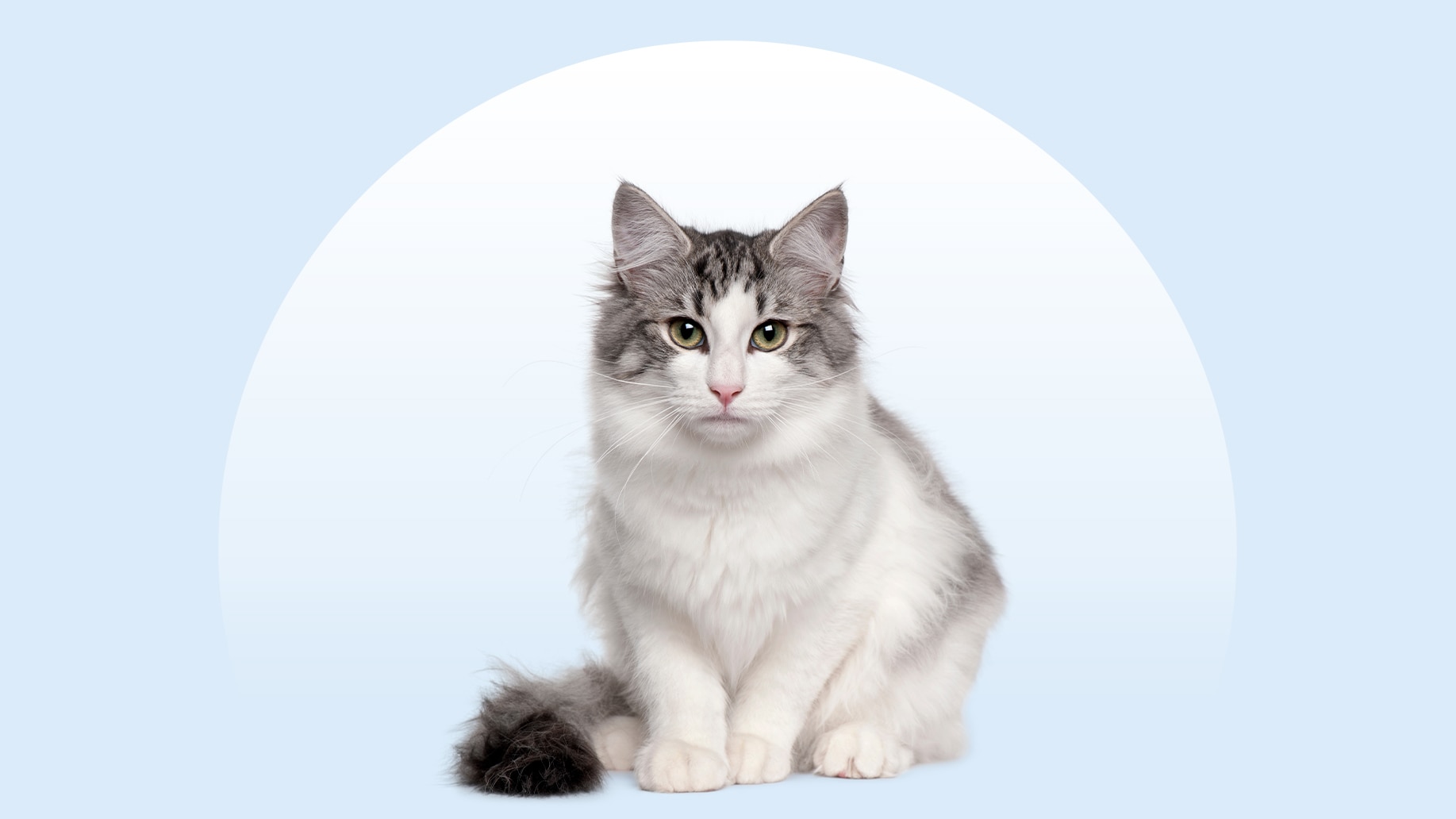
Norwegian Forest Cat
Updated May 4, 2026
Norwegian Forest Cats aren’t picky about who they chum up with, as long as daily play and weekly brushing are part of the deal. These Goldilocks cats are a great fit for families, multipet households, and dog-lovers alike—really, just about anyone looking for a loyal, easygoing companion.
Observant, Confident, Sweet
8–18 pounds
13–15 years
You don’t need to own a chariot to be the proud parent of a Norwegian Forest Cat—but according to legend, it might help.
This majestic breed, known as the skogkatt (or “forest cat”), was said to pull the chariot of Freya, the Norse goddess of love. Farmers believed that leaving out milk for her cats would bring a bountiful harvest—and maybe, just maybe, a little extra luck in love, too.
Norwegian Forest Cats (or Wegies, as fans call them) are equal parts myth and mischief: endlessly curious, deeply athletic, and deadly serious about their next jump, chase, or climb.
They look like they should be called Lord of the Forest, but they act like the chill guy at the party. Wegies are not the clingy type, but when they decide they’re in the mood, they melt right into you like a wet noodle.
So sure, a Norwegian Forest Cat might not actually guarantee you a fairytale romance—but you will end up completely, hopelessly in love with them.
Recommended Products



Norwegian Forest Cat Characteristics
Norwegian Forest Cat Appearance
You know what they say about pets and their people looking alike? Well, Norwegian Forest Cats make a strong case for it.
With their massive frontal ruff, tufted ears, and wild, shaggy coats, they’re giving Norse warrior—and we’re here for it.
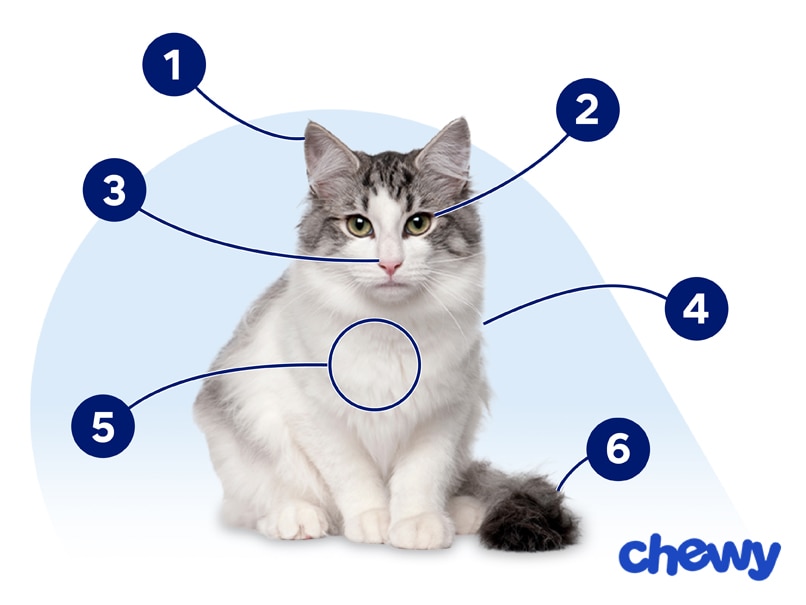
- Ears
Norwegian Forest Cats have large, wide ears that are angled slightly forward, as if they’re always listening. Some have long fur growing from the tips—called ear tufts or lynx tips—that adds to their wild look.
- Eyes
Large and almond-shaped, most often in shades of green, hazel, or gold. Wegies with white in their coat may have blue eyes or heterochromia (two different colored eyes).
- Nose
Their nose color often corresponds to their coat color.
- Coat Length
Norwegian Forest Cats have semi-long fur with a coarse, glossy topcoat that repels water and a thick, woolly undercoat. Perfectly built for Scandinavian winters, they even have a full ruff at the neck (their Norse beard, if you will) and longer fur that fans out at their hindquarters.
- Coat Color
Norwegian Forest Cats come in all coat colors, including black, blue, white, tabby, bi-color, tortoiseshell, and calico, among others.
- Tail
Norwegian Forest Cats have long, bushy tails.
Norwegian Forest Cat Temperament
For such a large, athletic cat, you might expect a demanding personality. But the Wegie takes a softer, more calculated approach.
Norwegian Forest Cats are playful but calm and observant—not frantic or high-strung. Athletic, but with focused intensity rather than random chaos. Loveable, but with selective affection that rarely tips into clinginess. When they have something to say, they keep conversation low-key—soft trills and chirps rather than demanding meows.
Their adaptability is part of what makes Wegies such a good fit for busy households. However, they don’t love chaos and, to be fair, most cats don’t. When the house gets loud, the kids get wild, or the energy tips from lively into overwhelming, a high-up perch or a quiet retreat can help keep your Wegie feeling cool and collected.
That said, they generally do well with kids as long as socialization starts early and teaching little ones how to interact gently with cats is a priority—a non-negotiable for any cat, really.
Introducing a Wegie to another cat or dog can also go smoothly with proper introductions and patience, though there are never any guarantees. At the end of the day, whether any two animals become besties comes down to individual socialization, personality, and proper introductions.
As for cuddling? The jury is split. Some Wegie parents say their cats are love bugs who treat vet visits like a kissing booth. Others say their Wegie isn’t much of a cuddler—but follows them from room to room and plants themselves nearby most of the day.
No matter your cat’s individual preferences, you’re sure to be loved.
Related Breeds


How to Care for a Norwegian Forest Cat
If you guessed that Norwegian Forest Cats have higher grooming needs than some other felines (we’re looking at you, domestic shorthair), you’d be right.
While all cats need routine brushing and nail trims, Wegies need a little extra hair care to keep their coat tangle- and debris-free. Just like any other cat, they also require daily play and exercise—and are surprisingly quick learners who enjoy picking up new tricks.
Grooming
Diet
Exercise
Environment
Norwegian Forest Cat Health
Norwegian Forest Cats have an average lifespan of 13–15 years, though many can live longer with proper care.
They’re considered a natural breed, meaning they originally developed through natural selection rather than intentional crossbreeding. This gives Wegies a relatively diverse gene pool and, in many cases, fewer inherited health issues than some purebred cats. Other natural cat breeds include the Maine Coon, Siberian, and Turkish Angora.
Some potential health conditions Wegies can develop include:
- Hypertrophic cardiomyopathy (HCM): This is the most common form of heart disease in cats. Initially, the condition is often asymptomatic, with no signs until the disease has progressed. Therefore, proactive screening is recommended, including a baseline cardiac ultrasound in young adulthood and continuing screenings as often as your vet recommends. Reputable Norwegian Forest Cat breeders should evaluate their breeding cats for the condition every year or two.
- Hip dysplasia: Big cat breeds, including Wegies, are more susceptible to bone and joint conditions such as hereditary hip dysplasia. Signs include changes in gait and activity, like stiffness, limping, or a reluctance to jump. Keeping your Wegie at a healthy weight is will help, and your vet may also recommend anti-inflammatory medications, joint supplements, and lifestyle adjustments.
- Obesity: With their thick coats and large frames, it can be surprisingly difficult to gauge a Norwegian Forest Cat’s true body condition by sight alone. According to Dr. Whittenburg, when viewed from above, your cat’s waist should tuck in slightly behind the ribs, and from the side, the belly should tuck up slightly. With all that fur, this can be hard to see. She recommends evaluating by feel instead. “You should be able to feel their ribs and spine when you gently run your hand over them,” she says. While at-home check-ins are important, she adds that the most reliable way to monitor your cat’s weight is with regular wellness visits with your veterinarian.
- Parasites: Parasites aren’t specific to Norwegian Forest Cats—they’re a risk for all cats, even those who live strictly indoors. Fleas, ticks, intestinal parasites, and even mosquitoes can make their way inside, and once they do, they can cause more than just irritation. Parasites can lead to secondary infections and other problems, including heartworm disease. “I recommend a broad-spectrum preventative that will protect them from fleas, ticks, heartworm, and intestinal parasites,” says Dr. Whittenburg. Revolution Plus is a monthly topical option that covers all of the above and can be applied at home.
Norwegian Forest Cat History
According to Norse mythology, the goddess Freya had a particular soft spot for the skogkatt—the “forest cat” we now know as the Norwegian Forest Cat. These cats were depicted as massive and almost otherworldly, strong enough to pull the chariot of the goddess of love, beauty, and fertility. Not exactly your everyday house cat.
While not actually larger than life, Norwegian Forest Cats are still impressive. They developed naturally in the harsh Scandinavian climate, evolving a thick, water-resistant double coat, large paws for navigating snow, tufted ears, and a long, bushy tail for warmth. As early as the 16th century, cats resembling the breed were pictured in Norwegian folk tales, where they were called Hulderkatts, or “troll cats.”
It’s believed that Viking explorers brought Forest Cats along on their voyages—not for luck in love, but for rodent control aboard ships. This would have placed Wegies in North America as early as the late 900s AD, though that has never been confirmed.
The Norwegian Forest Cat Club was established in Oslo in 1938 to formally preserve the breed. However, World War II interrupted those efforts, and the breed came dangerously close to disappearing through interbreeding with domestic shorthairs.
Fortunately, dedicated breeding programs were able to bring them back from the brink—a comeback worth celebrating. King Olaf of Norway agreed, designating the Norwegian Forest Cat the official cat of Norway.
The first breeding pair arrived in the United States in November 1979, and TICA became the first North American registry to grant the breed Championship status in 1984.