Are All Orange Cats Male and All Calico Cats Female?


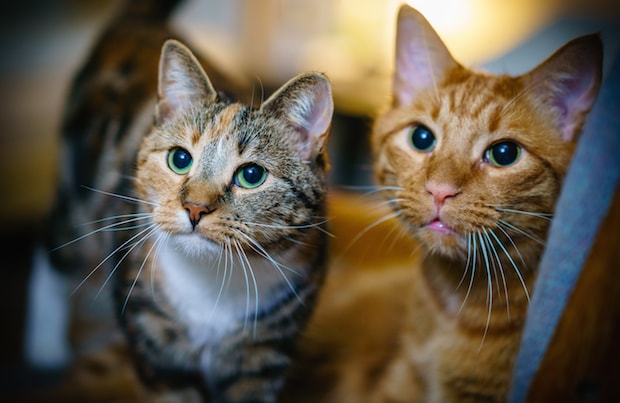
Photo by Chewy
Most of the time, a kitten’s coat color tells you very little about the cat they’ll grow up to be. For example, despite the stereotype, orange cats aren’t always wilder than their gray or brown counterparts.
But are all orange cats male, and are all calico cats female? Unlike personality stereotypes, sex and coat color are actually linked in cats. The result? Most orange cats are male, and most calicos and torties are female, though exceptions exist.
Key Takeaways
- Most orange cats are male, while most calico and tortoiseshell cats are female.
- A cat’s coat color is determined by genetics—but their color doesn’t influence their personality.
- Female orange cats and male calico cats are less common, but they do exist.
- Orange and calico are not cat breeds; these coat patterns can appear in many different breeds.
What Do Orange Cats and Calico Cats Look Like?
Orange and calico aren’t cat breeds. Instead, they’re coat colors and patterns that appear across many breeds of cats, which is one reason these traits aren’t a good predictor of personality or temperament.
Calico Cats
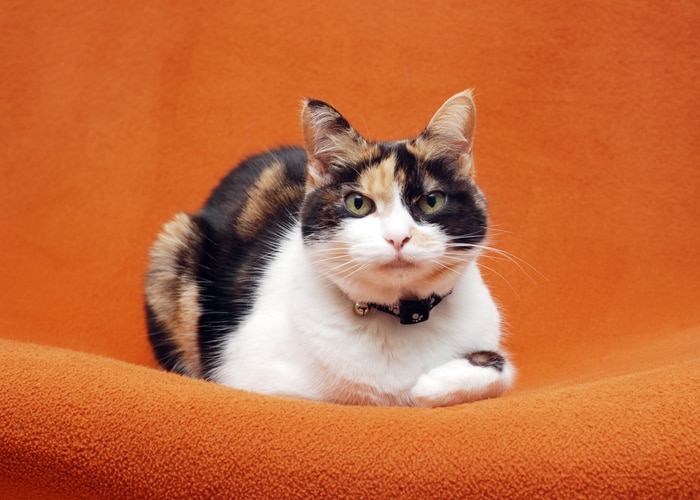
A calico cat.
Photo by AnthonyRosenberg/iStock/Getty Images Plus via Getty Images
Calico cats, like the one pictured above, have large patches of white along with smaller patches of orange and black, brown, chocolate, or a diluted gray-blue.
But don’t confuse this with a tortoiseshell cat (or tortie cat), pictured below, who has a mottled pattern of black and orange with little to no white.
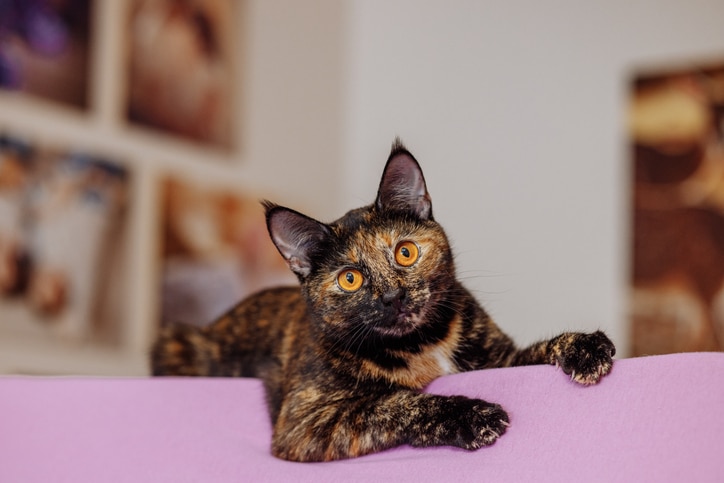
A tortoiseshell cat.
Photo by Liubov Kaplitskaya/iStock/Getty Images Plus
Orange Cats
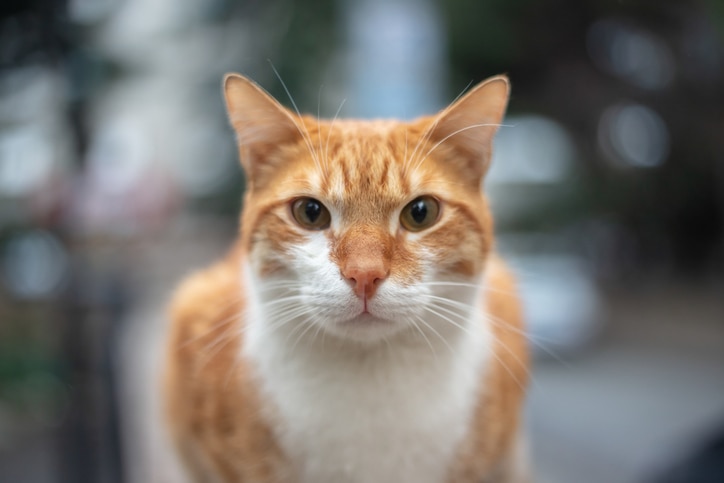
An orange cat.
Photo by Berk Ucak/E+ Via Getty Images.
Orange cats are, well, orange—but look closely and you’ll likely notice:
- An “M” marking on the forehead
- Stripes, swirls, spots, or bands of light and dark orange across their body
That’s because every orange cat is actually an orange tabby.
The orange gene doesn’t mask tabby striping the way other coat colors can, so the pattern always shows through.
Orange cats also sometimes have a white patch on their chest, called a locket, but that’s a separate genetic trait unrelated to the orange gene itself—some orange cats have lockets, some don’t.
Why Are Orange Cats More Often Male?
About 80% of orange cats are male, while only 20% are female—a pattern finally explained at the genetic level in 2025. A male cat needs only one copy of the orange gene to be orange, while a female cat needs two.
Hair or fur color is typically unrelated to sex, but in cats and hamsters, orange is the exception. Dubbed “sex-linked orange,” this gene lives on the X chromosome. That means a male cat (XY) only needs one orange gene to be orange—he gets just one “vote.” A female cat (XX) has two X chromosomes, so she gets two votes, needing orange genes on both Xs to be fully orange.
The exact odds of an orange kitten depend on the parents, though the chances climb as high as 100%.
If mom is solid orange (meaning both of her X chromosomes carry the orange gene), all her male kittens will be orange, because no matter which X she passes down, it’s orange.
Can an Orange Cat Be Female?
Yes, orange cats can be female, but it’s less common than an orange male.
To get an orange female kitten, both the mother and father must carry the orange gene.
Are Calico Cats Always Female?
No, calico cats aren’t always female—but most are. Like the orange coloration, the pattern starts on the X chromosome.
To be calico, a female must inherit the orange gene on one X chromosome and a non-orange gene on the other. Her body then randomly “shuts off” one X chromosome in each cell during early development, creating patches of each color across her coat.
A calico cat must also inherit the white spotting gene, which is separate from the X chromosome. This gene creates the white areas by interrupting pigment cells during development.
Without the white spotting gene, the result is a tortoiseshell cat—orange-and-black mottled fur without large white patches. Together, these traits create the classic calico pattern: white with orange and black patches.
Can a Calico Cat Be Male?
Yes, a calico cat can be male, but it’s extremely rare—roughly one in 3,000 calico cats are male. Remember, calico coloration requires three things: the orange gene on one X chromosome, the non-orange gene on the other, and at least one copy of the white spotting gene.
So how does a male cat, who’s only supposed to have one X chromosome, pull this off?
The answer is a genetic fluke called Klinefelter syndrome—a male cat born with XXY chromosomes instead of the usual XY. That extra X gives him the two different color genes he needs for calico or tortie coloration, just like a female. Male calicos are almost always sterile as a result of that extra chromosome.
Why Is Color in Cats Linked to Gender?
Not all coat colors in cats are linked to sex—just orange, and, well, not orange. You can think of fur color as a two-step process:
Step 1: Do I have the orange gene? This is the only sex-linked decision, and it happens on the X chromosome.
- If a male has it, he’s orange. If not, he moves to step two.
- A female needs two copies to be fully orange. If she has one copy of each—orange and non-orange—she becomes a calico or tortoiseshell instead. If she has two copies of the non-orange gene, she moves to step two.
Step 2: If I’m not orange, what color am I?
- Sex no longer matters here. Whether a cat ends up black, brown, chocolate, cinnamon, or gray depends on a separate set of inherited genes—called autosomal genes—that have nothing to do with the X or Y chromosome.
So, if you have an orange or calico cat, now you know how they got their color. Just don’t try to predict personality from it—chances are, they’re a delight either way.
FAQs About Orange Cats and Calico Cats
Can an orange cat be female?
Yes. About 20% of orange cats are female.
Can a calico cat be male?
Yes, but it’s very rare. Roughly one in 3,000 calico cats is male, and these cats are almost always sterile.
Do orange cats have wild personalities?
Some orange cats might be a little wild, but it’s not because they’re orange. Your orange cat might be goofy, shy, cuddly, playful, or a mix of all of the above. That personality is shaped by genetics, socialization, and life experience, not by coat color or gender.
Attributions