Collie
Updated June 22, 2026

Collie
Updated June 22, 2026
Has there ever been a more quintessential family dog? Made famous by the TV show “Lassie,” the Collie is an easygoing, smart pup who’s keen on adventure. They have lots of love and loyalty to give a deserving person or family.
Cheery, Friendly, Loyal
50–75 pounds
22–26 inches
12–14 years
Black White and Tan, Blue Merle, Blue Merle and White, Blue Merle and White and Tan, Sable, Sable and White, Sable Merle, Sable Merle and White, White, White Merle
If there’s one thing you’re sure of, your Collie loves you: Who else would look at you so adoringly with such bright eyes? Why, then, does your Collie also look at your partner like that? And your neighbor? And the guy who just delivered your pizza?
The truth is, your Collie will probably love everyone, and you’ll have to be OK with sharing them. They’ll be delighted to be invited along to greet new friends.
Collie Characteristics
Collie Appearance
The Collie dog breed possesses a natural elegance and spirit that gives them a proud, graceful appearance. Whether it’s the longer-coated Rough Collie dog or the shorter-coated Smooth, Collies are delightful medium-sized dogs with a distinctive mixed color coat—and that unmistakably pointed and friendly Collie face.
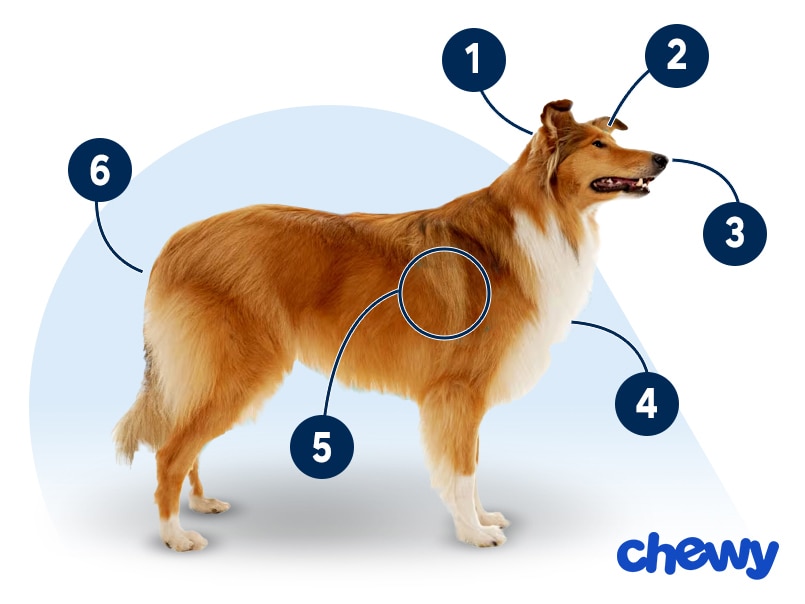
- Ears
Collie ears fold over slightly at the tops, even when alert.
- Eyes
Their dark eyes are almond-shaped. Dogs with merle coats are the exception: Their eyes can be blue or merle, too.
- Nose
The breed's nose is black, and the overall muzzle shape is tapered and somewhat long.
- Coat Length
The Rough Collie puppy or adult has a double coat with the outer layer long and thick. The Smooth Collie puppy or adult also has a double coat, but the outer layer, in this case, is only an inch or two long. You can also think of them as longhaired Collies or shorthaired Collies.
- Coat Color
Collies come in 10 standard colors, including black, white, and tan; blue merle (mottled patterns); blue merle and white; blue merle, white, and tan; sable (lighter at the base, darker at the tip); sable and white; sable merle; sable merle and white; white merle; and white. (Solid-color Collies are usually white, but they’re rarer.)
- Tail
Collie tails are long and quite fluffy.
Collie Temperament
Collies are the quintessential extroverts. They’re gregarious companions who love their family above all else.
Be warned, though: They love most people they meet. Don’t get jealous; just be happy you have such a cheery, easygoing pup to call your own.
These pups love to be active; they are not couch potatoes. They’ll love the call of the great outdoors and appreciate pet parents who also enjoy those activities.
Collies tend to get a little chatty if they’re lonely or bored, so take any excessive noise as a note that they need more exercise or mental stimulation. Extra walks, games, or snuggles can help.
Impressively, the Collie temperament is so delightful and even-keeled that they’re often used as service dogs; they also retain training and can adapt to a variety of situations, making them perfect for the role.
Related Breeds








How to Care for a Collie
Collies are high-energy dogs who shed a lot, but they’re still a great choice for first-time pet parents, and they’re easy to train.
Grooming
Training
Diet
Exercise
Environment
Collie Health
The average Collie life expectancy is 12–14 years. Here are some health issues to be aware of.
- Bloat and gastric dilatation-volvulus (GDV): Collies, like many deep-chested breeds, are prone to a life-threatening condition called bloat. It occurs when the stomach gets distended with air and/or food. A serious complication is gastric dilatation-volvulus, when the stomach twists, and symptoms include abdominal distension, restlessness, and dry heaving. If you notice these signs, go to the vet immediately.
- Eye issues: Collies are prone to two potential genetic eye abnormalities: collie eye anomaly (CEA) and progressive retinal atrophy (PRA). There are genetic screening tests for both conditions, but neither has a cure. Blind dogs or those with limited vision can still have good quality lives.
- Hip dysplasia: Hip dysplasia occurs when the ball and socket of the hip and thigh bones don’t properly fit; it can be an inherited condition. It often results in pain, limping, and arthritis. Treatment options include weight management, physical therapy, joint supplements, pain medication, and, in severe cases, surgery.
- Multidrug resistance mutation (MDR1): MDR1 is a genetic condition that makes dogs more prone to serious side effects of certain medications. For example, ivermectin is used for the treatment of mites and some intestinal parasites; it’s usually given at high doses, which can be problematic for dogs with this gene mutation. Consider a genetic screening test and discuss medications with your vet.
- Skin issues: Collies can develop immune-related skin diseases, including dermatomyositis and pemphigus foliaceus. Both can be treated with medications, but there is no cure.
Collie History
Collies hail from Scotland, where they were used for centuries to herd sheep on farms. Their kind personalities, herding skills, and devotion to family were highly valued.
But after Queen Victoria took notice of the breed in the 1860s, their popularity skyrocketed, and the dogs quickly went from working pups to highly prized pets.
In the 1870s, Collies came to the United States, and the American Kennel Club recognized the breed in 1885. The Collie Club of America was established in 1886 to honor the breed.
While the Collie breed’s initial burst of popularity had royal roots, it was the 20th-century writings of Albert Payson Terhune (author of “Lad, a Dog,” and other books about Collies) and Eric Knight (author of “Lassie Come Home”) that gave the breed broader fame as a loyal family companion.
“Lassie” movies and a television series followed from the 1940s through the 1970s, cementing the pup’s popularity.
Collie puppies tend to cost thousands of dollars. If you choose this route, pick a responsible breeder.
You can also adopt a Collie, as there are many of these pups searching for their forever homes. Reach out to a Collie rescue, like the Tri-State Collie Rescue; keep an eye out for the breed at your local shelter; or search Chewy’s database of adoptable dogs in your area.