
Friesian
Updated September 29, 2026
Friesian
Updated September 29, 2026
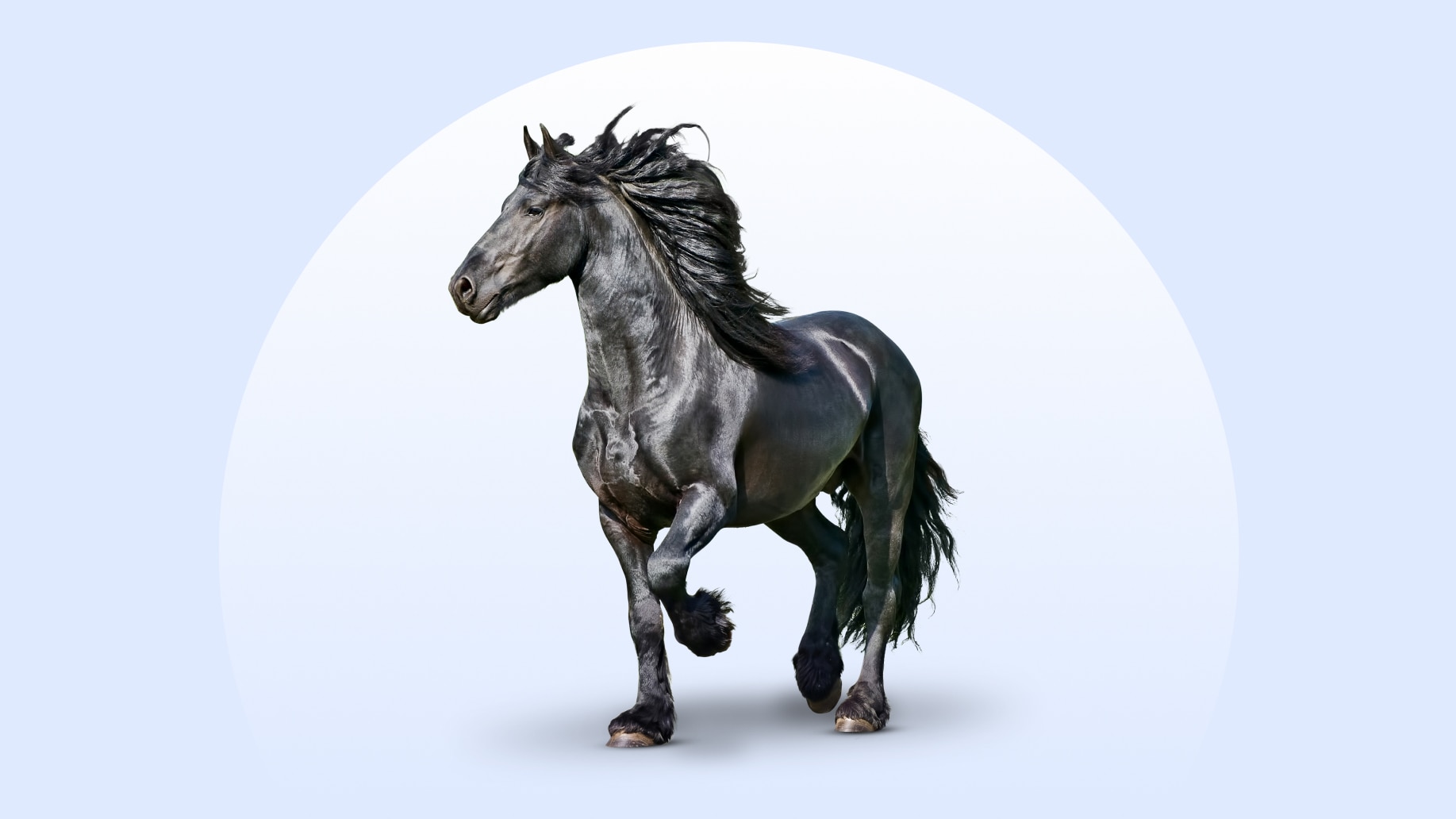
The Friesian is a striking horse breed from Friesland, a province in the Netherlands. They're large, versatile horses known for their black coats, abundant hair, and high-stepping trot.
Friendly, Intelligent, Willing
1,300+ pounds
15.1–17.3 hands (61–71 inches)
16–30 years
Primarily black; black bay and dark brown can occur, and chestnut is uncommon. Purebred show standards permit only a small star as a white marking
Known for a black coat, long mane and tail, feathered legs, and animated movement, Friesians have been used as war horses, carriage horses, and modern riding and driving partners. They’re intelligent and willing to work, but their grooming and health needs can require extra attention.
Friesian Appearance
Friesians combine a substantial build with an elegant appearance. Their most recognizable features include a black coat, thick mane and tail, long feathering around the lower legs, and an energetic, high-stepping trot. The overall look has helped make Friesians popular in the show ring and entertainment.
- Colors and Patterns
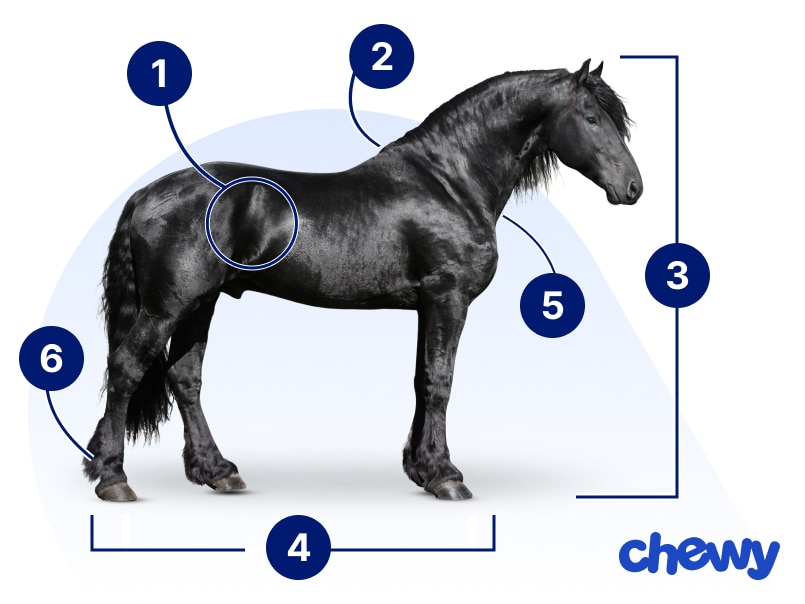
Purebred Friesians should be black, although sun fading is permitted. Chestnut or brown mares and geldings are permissible but not desirable. A small star on the forehead is permitted.
- Height
The desired range for mature purebred Friesians is 15.1–17.3 hands (61–71 inches).
- Conformation
Friesians are substantial horses weighing 1,300 pounds or more. They have a rectangular and muscular build.
- Movement
Friesians are known for their high-stepping trot. Their energetic movement helps make them suitable for disciplines such as dressage and driving.
- Head and Neck
A high-set arched neck lends to the Friesian’s elegance, with small ears and large, expressive eyes.
- Legs and Hooves
Feathering—the long hair around the lower legs—is characteristic of Friesians. USEF expects age-appropriate feathering in purebred Friesians, although a lack of feathering is not penalized.
Friesian Temperament
Every horse has an individual personality, but Friesians are generally described as friendly, intelligent, easygoing, and eager to please. They are willing workers who enjoy being active and can form close bonds with people.
Their intelligence and willingness can also make them straightforward to train. A well-trained Friesian may work with riders and trainers at different experience levels, including younger riders who are comfortable handling a horse of this size.
Friesians are versatile, with dressage and driving among their standout disciplines. They can also participate in hunt and saddle seat, trail riding, and pleasure riding. USEF maintains competition rules specifically for purebred and part-bred Friesians.
Related Breeds
How to Care for a Friesian
Friesians require many of the same basic care practices as other horses, but their abundant hair adds to their grooming needs. Horse owners also need to watch their weight because Friesians may gain weight easily. Breed-specific health risks make routine veterinary care and appropriate genetic testing particularly important.
Grooming
Training
Diet
Exercise
Environment
Friesian Health
Friesians are predisposed to several health conditions. Genetic testing is available for some inherited disorders and can help guide responsible breeding decisions.
- Aortic rupture: Friesians can experience rupture of the aorta, which may cause sudden death. The condition often affects the aortic arch in this breed, and may be associated with a connective tissue disorder.
- Hydrocephalus: This inherited disorder causes excessive fluid to accumulate in the brain, producing severe enlargement of the skull. Affected Friesian foals may be aborted, stillborn, or born with severe neurological problems. A genetic test is available, and avoiding carrier-to-carrier matings can prevent affected foals.
- Friesian dwarfism: This inherited condition causes disproportionate growth, including shortened limbs and ribs. Other signs can include bowed forelegs, a shortened neck, a broad chest, and hyperextended fetlocks. There is no treatment, but affected horses can have a good quality of life. Genetic testing can identify the causative mutation.
- Megaesophagus: Friesians may develop an enlarged esophagus that does not move food effectively toward the stomach. Signs can include difficulty swallowing, choke, drooling, weight loss, and aspiration pneumonia. Management may include specially prepared food (such as soaking) and elevated feeding.
- Distichiasis: With this condition, eyelashes grow from an abnormal location along the eyelid and may irritate the cornea or contribute to corneal ulcers.
Friesian History
Friesian horses originated in Friesland, a province in the Netherlands, and the breed dates back to the Middle Ages. Historically, Friesians served as war horses and carriage horses.
Their modern role is much broader. Friesians are used for riding, driving, farm work, equestrian competition, and pleasure riding. Their dramatic appearance has also made them popular in movies and other entertainment.
Friesians can compete in registered horse shows. The current USEF rulebook includes a dedicated Friesian and Part Bred Friesian chapter covering in-hand, park horse, English pleasure, country English pleasure, and other classes.
FAQs
Where did Friesian horses get their name?
How big do Friesian horses get?
How long do Friesian horses live?
Are Friesian horses good for beginners?
Is a Friesian horse a warmblood?
This article was created with assistance from AI tools. The content has been reviewed for accuracy and edited by a human.