Manx Cat
Updated July 10, 2026
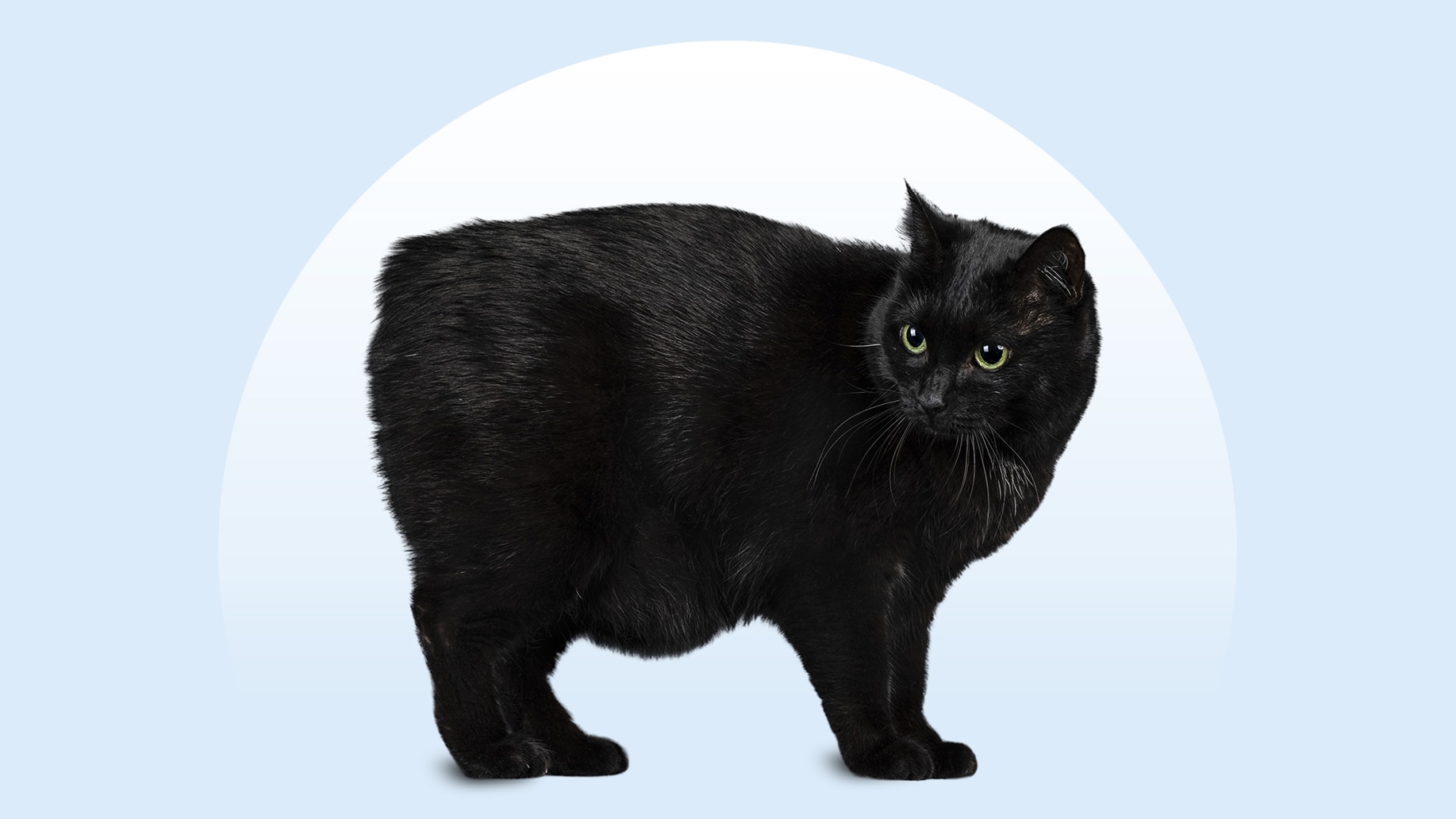
Manx Cat
Updated July 10, 2026
The Manx is a devoted, forever-playful cat breed with a big personality. Equal parts dog, rabbit, and kitten, they’re best suited for those who want a loyal, interactive companion who will follow them from room to room and greet you at the door—because seeing you is the best part of their day.
Playful, Easygoing, Affectionate
8–12 pounds
16–20 years
Loyal to a fault, forever playful, and smart enough to learn a trick or two (fetch, anyone?), the Manx is the kind of cat who picks their person and never leaves their side—though they’re cool if you run a few errands.
But here’s where a lot of people get the Manx wrong: Manx cats are not defined by their tail—or lack of one. A Manx is a Manx because they come from the Isle of Man, a small island in the Irish Sea between Britain and Ireland. A tailed Manx is just as Manx as a tailless one; they just have a little more to say (cats communicate a lot with their tail).
Manx Cat Characteristics
Manx Cat Appearance
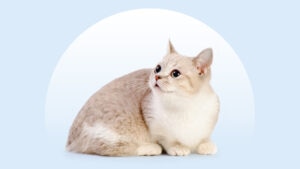
Manx cats have a rather round appearance: round eyes, a round head, a rounded body.
And those legs. The Manx’s hind legs are longer than their front, giving them an elevated rump and a gait that’s sometimes more rabbit than cat.
Then there’s what the breed standard calls “a great depth of flank,” or a roundness of the body between their ribs and hindquarters. Essentially, they have a cute round belly.
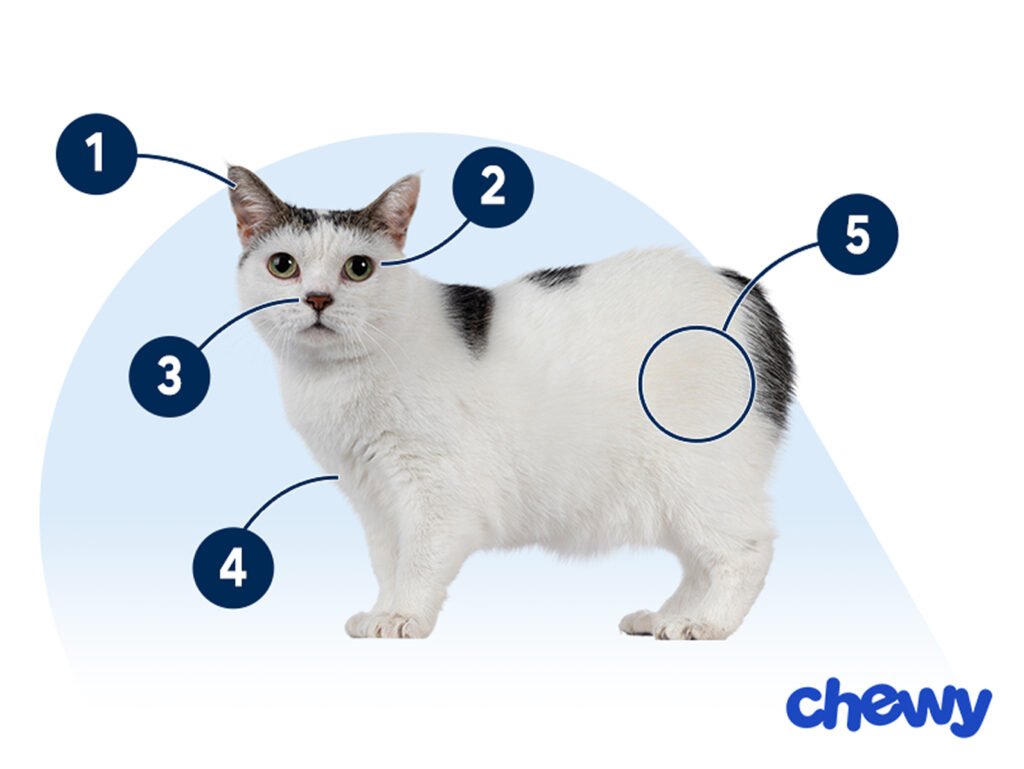
- Ears
Manx ears are wide at the base and taper to a rounded point. Shorthaired Manx typically don't have ear furnishings—those long, wispy tufts of hair inside the ear—while longhaired Manx often do.
- Eyes
Manx have big, round eyes that come in a range of colors corresponding to coat color, including gold, copper, green, hazel, blue, and odd-eyed.
- Nose
Nose leather also corresponds to coat color and can range from pink, black, blue, brick red, and rose, to mottled with pink.
- Coat Length
The Manx has a dense double coat with guard hairs on top. They come in both short and long coats; while Cat Fanciers’ Association registers both under the Manx name, The International Cat Association calls a Manx with long hair a Cymric.
- Coat Color
TICA accepts all coat colors and patterns while CFA accepts all colors and patterns except chocolate, lavender, the Himalayan pattern (points), and any of these combined with white.
- Tail
Manx can be completely tailless (called a rumpy), partially tailed (riser and stumpy), or fully tailed (longy). The longer the tail, the lower the likelihood of neurological and musculoskeletal complications.
Manx Cat Temperament
Manx are deeply devoted to their family, whether that be dogs, kids, or other cats. But at the end of the day, the Manx is a one-person cat at heart (brownie points if you’re the one delivering their meals).
While they’ll happily follow you from room to room, they’re also independent enough to handle a few hours alone, especially if they have their favorite toys and a window perch at their disposal.
Their elevated rump and round build shouldn’t limit their ability to run and jump, but they’re also not ones to seek out refrigerators and cabinets to scale. The Manx is better described as equal parts dog and rabbit: dog-like in their playfulness, social streak, and love of learning new tricks (including fetch), and rabbit-like because those longer hind legs give them a gait that looks a lot like a bunny hop.
Related Breeds


How to Care for a Manx Cat
Manx don’t ask that you spend every hour of every day with them, but they still need time with their number one—you. Bonding looks different for every cat, but many Manx appreciate gentle grooming, daily play, and quality time.
Grooming
Diet
Exercise
Environment
Manx Cat Health
According to TICA, the average Manx cat lifespan is 16 or more years, similar to the average lifespan of other healthy cat breeds. Still, the Manx is a breed that comes with important health considerations.
The gene responsible for the Manx’s shortened tail affects the development of the caudal vertebrae—the bones below the pelvis that form the tail. In more extreme cases, such as in rumpy or stumpy Manx, the sacral vertebrae at the base of the spine can also be affected.
Those structural changes can impact the nerves controlling the hind legs, bladder, and bowel, explains Bruce Kornreich, DVM, a feline cardiologist and director of the Cornell Feline Health Center at Cornell University College of Veterinary Medicine. The longer the Manx’s tail, the lower the risk.
Health concerns Manx cats face are:
- Manx syndrome: A group of conditions, including spinal problems, urinary and fecal incontinence, constipation, and hindlimb weakness, that can occur in Manx cats. These conditions are not caused directly by the Manx gene itself but are secondary effects of a shortened tail. The symptoms appear at higher rates in Manx cats with rumpy and stumpy tails, and irresponsible breeding practices significantly increase that risk.
- Megacolon: Rumpy Manx are at the highest risk of megacolon due to nerve damage affecting colon function. When chronic constipation goes unmanaged, it can eventually stretch the colon to the point it can no longer contract properly to move waste, a condition known as megacolon. Treatment options range from dietary changes and laxatives to hospitalization or surgery in severe cases.
Manx Cat History
To accompany their varied tail lengths, there are different tales of how the Manx came to be. One claims the breed resulted from crossing a large hare with a cat—which would explain that rabbit-like gait. But the Manx is actually a naturally occurring breed that developed on the Isle of Man.
How they got there is another question. One theory suggests they’re related to the Norwegian Forest Cat, brought to the island as early as 768 CE when Norwegian Vikings raided the Isle of Man.
Manx cats were prolific hunters, which earned them a valued place aboard early ships as mousers. While the Manx gene spread to areas outside the Isle of Man through seafaring ships, the gene pool on the island itself remained small.
The gene responsible for shorter or absent tails is naturally occurring, likely amplified by generations of inbreeding among a limited island population. Which is why, in more recent years, Persian cats were permitted as an outcross to introduce new genetic diversity into the breed.
Today, the Manx is beloved for their playful personality and adaptability. While the tailless look may be what first catches the eye, tailed Manx are just as special.