Scottish Deerhound
Updated June 8, 2026
Scottish Deerhound
Updated June 8, 2026
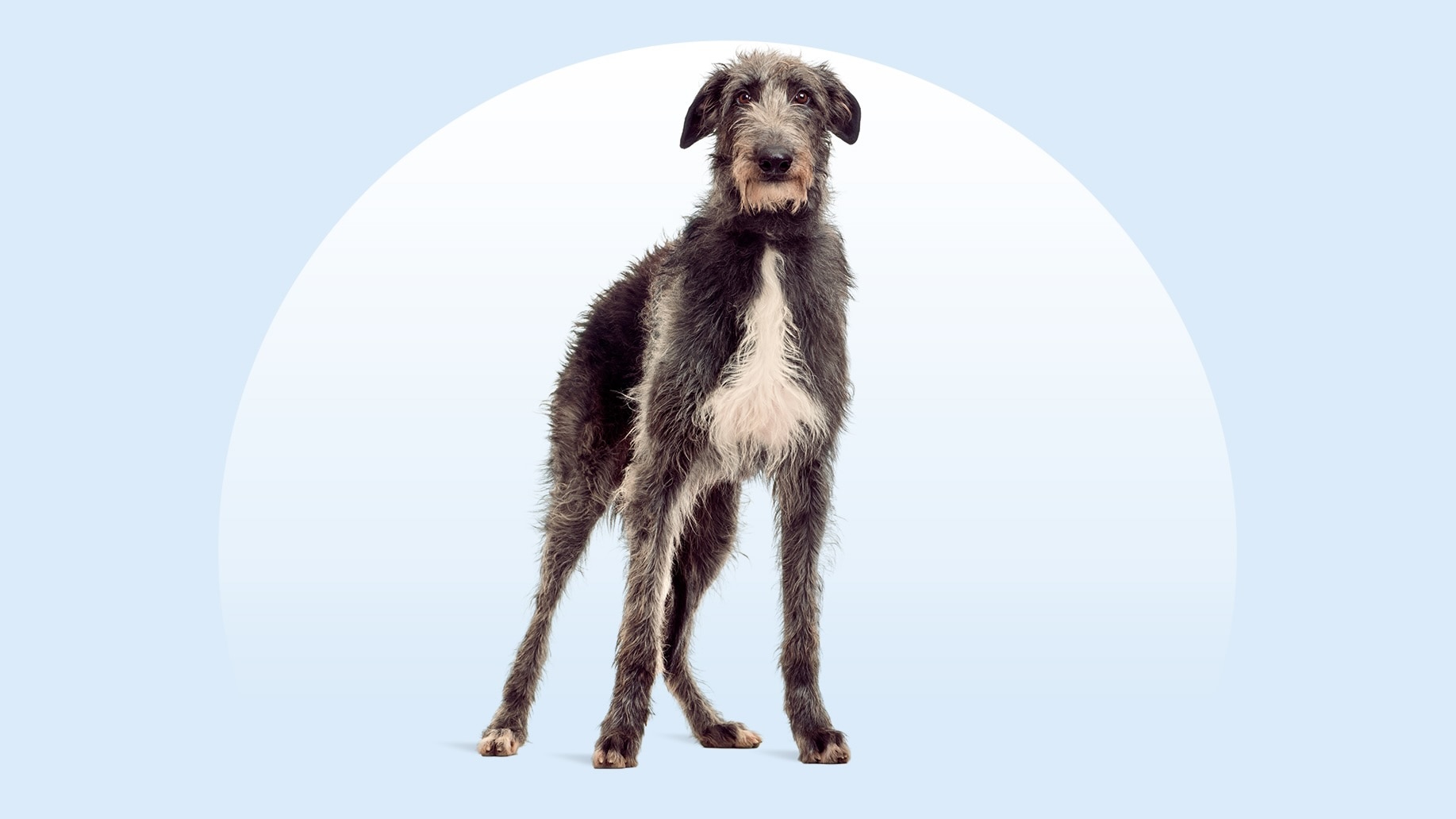
Scottish Deerhounds are giant dogs whose endearing mix of scruffiness and majesty will work their way into your heart. These sight hounds’ sweet nature and keen athleticism are best nurtured by families who can provide attention and exercise in equal measure.
Gentle Giant, Elite Athlete, Perceptive Pal
75–110 pounds
28–32 inches
8–11 years
Blue Gray, Brindle, Gray, Gray Brindle, Black, Black Brindle, Blue
If you’ve ever wanted a furry, friendly shadow, look no further than the Scottish Deerhound. Bred to hunt wild red deer in the Scottish Highlands, these sight hounds were (and still are!) more than mere lure coursing champs. They have long served as gentle, affectionate companions who are happy to accompany their humans wherever they’re going.
As the Scottish Deerhound Club of America (SDCA) notes, “The depth of your relationship with your Deerhound is limited only by how much love and time you put into it.” Given that Sir Walter Scott once described Deerhounds as “the most perfect creature of heaven,” you won’t need much motivation to invest your time and energy into the relationship.
Scottish Deerhound Characteristics
Scottish Deerhound Appearance
Scottish Deerhounds look somewhat similar to Greyhounds but with two important differences that are arguably their most unique characteristics.
First, Deerhounds are significantly larger than Greyhounds, topping out at an impressive 32 inches at the withers. (For perspective, the average adult desk height is around 28–30 inches.) Second, Scottish Deerhounds have wiry, moderately long fur.
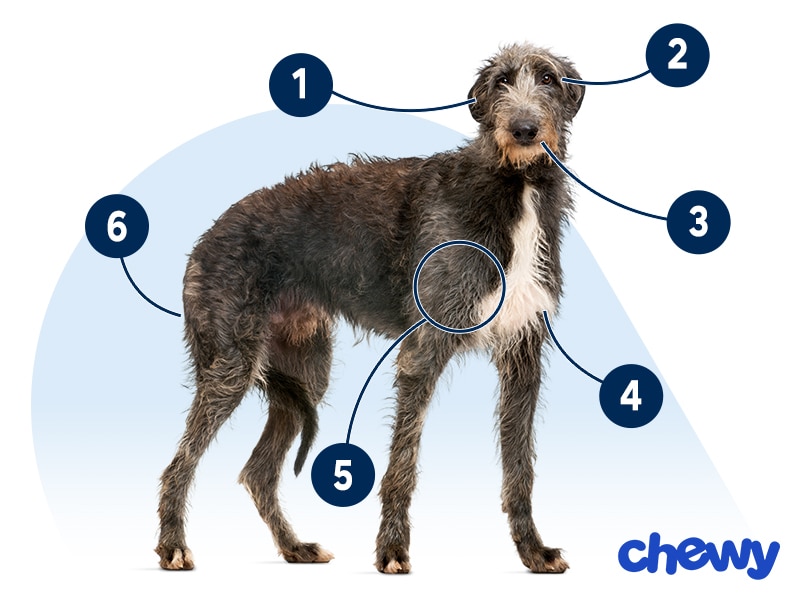
- Ears
Scottish Deerhounds have high-set ears that rest folded backward. The breed standard describes their texture as “soft, glossy, like a mouse’s coat to touch,” standing in stark contrast to the bristly fur on their body.
- Eyes
The Scottish Deerhound’s eyes range from dark brown to hazel in color and are rimmed in black.
- Nose
Their nose is typically black but can be bluish-gray. It is also slightly aquiline, or curved, in shape.
- Coat Length
The Scottish Deerhound’s characteristically coarse coat is 3–4 inches long.
- Coat Color
Their fur can be blue-gray, brindle, gray, gray brindle, black, black brindle, or blue. According to the breed standard, dark blue-gray is the most preferred color.
- Tail
Scottish Deerhounds have a long tail that comes within 1.5 inches of the ground.
Scottish Deerhound Temperament
The Scottish Deerhound is a beautifully balanced breed. For example, while they are naturally majestic athletes bred to bound over harsh terrain in pursuit of deer four times their size, Scottish Deerhounds can just as easily earn a “couch potato” designation, especially as adults. That’s because what Deerhounds really prize is companionship—they want to be where their humans are, whether that calls for exercise or relaxation.
This human-centric orientation means that Scottish Deerhounds are incredibly gentle, calm, and attuned to their families. They get along with people of all ages and with many dogs as well, but because of their size, it’s important to monitor their interactions.
However, it’s important to note that Deerhounds have a strong prey drive. This instinct can lead them to chase animals of all sizes, including squirrels, rabbits, cats, deer, and even other dogs. Always make sure introductions to other pets are done properly and that your Deerhound is safely on a leash or within a fenced area when outside.
Related Breeds


How to Care for a Scottish Deerhound
On the whole, Scottish Deerhounds are easy on the eyes, easy to groom, easy to train, and easy to get along with. If you add a Deerhound to your family, most of your time will be spent providing both exercise and attention.
Grooming
Training
Diet
Exercise
Environment
Scottish Deerhound Health
The average Scottish Deerhound lifespan is 8–11 years. Like all dogs, they are prone to certain health conditions. It’s important to partner with an ethical breeder who prioritizes health and genetic testing.
- Bloat and gastric dilation-volvulus: Bloat in dogs occurs when gas and/or food cause the stomach to expand. Sometimes, bloat progresses into a condition called gastric dilatation-volvulus (GDV), in which the dog’s stomach twists and cuts off blood flow to and from the stomach and spleen. GDV is painful and a life-threatening emergency. Signs include retching or dry heaving without vomiting, a swollen abdomen, sudden anxiety, pacing, panting along with drooling, and collapse. If you notice any of these signs, seek immediate veterinary care.
- Dilated cardiomyopathy: Dilated cardiomyopathy (DCM) occurs when the heart muscle becomes weak leading to an enlarged heart that can’t effectively pump oxygenated blood throughout the body. An irregular heartbeat can also develop. Signs include rapid or difficult breathing, weakness, an inability to exercise, coughing, and lethargy. There isn’t a cure, but medication can help manage the condition.
- Osteosarcoma: Osteosarcoma is a malignant bone cancer that occurs most commonly in the legs of large and giant dog breeds. There isn’t a cure, but surgery, chemotherapy, radiotherapy, and pain management can extend a dog’s quality of life.
- Hypothyroidism: Hypothyroidism occurs when a thyroid hormone deficiency affects metabolic function. Symptoms can include unexplained weight gain, lethargy, inability to stay warm, mental dullness, poor coat quality, skin infections, and ear infections. Treatment typically requires lifelong hormone replacement therapy.
Scottish Deerhound History
The Scottish Deerhound is a very old breed, which is why the dogs’ exact origins remain somewhat of a mystery. However, we do know that the nicknamed “Royal Dog of Scotland” was bred to hunt deer in the Scottish Highlands and that only people with the rank of earl or higher were allowed to own one.
The breed gained American Kennel Club (AKC) recognition in 1886.