Can Dogs See Ghosts?


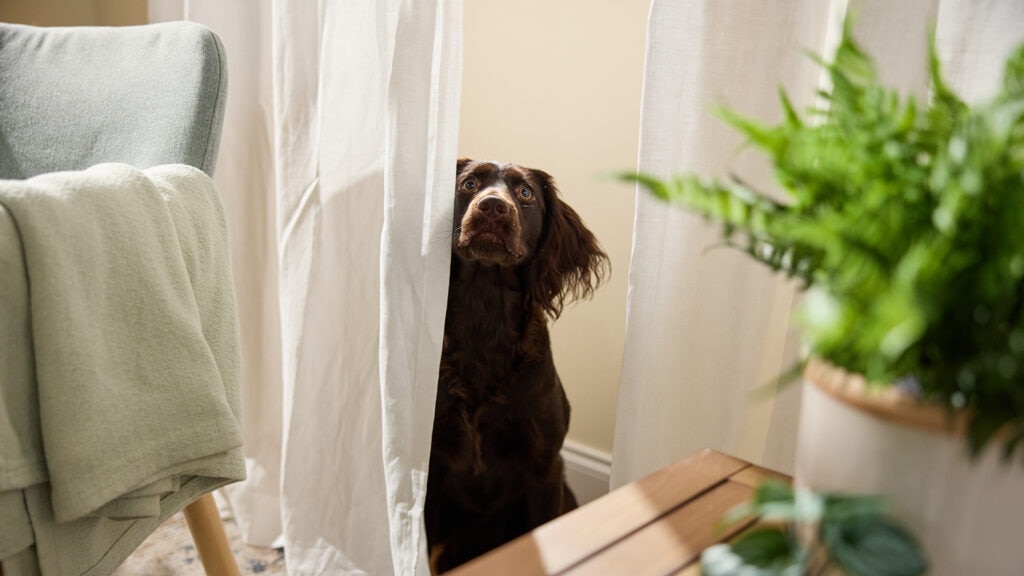
Photo by Chewy
Your dog is snoozing peacefully when they suddenly lift their head, stare at a blank wall, and let out a couple of low barks. You look. You listen. Nothing. So, what exactly are they reacting to? Can dogs see ghosts—and should you be concerned about your home’s possibly haunted status?
While there’s no scientific evidence that dogs can see ghosts, there are plenty of everyday explanations for their seemingly spooky behavior.
Here’s what could be going on and when to check in with your veterinarian.
Key Takeaways
- There is no scientific evidence that dogs can see ghosts.
- Dogs can detect some sounds, scents, and movements that humans may miss.
- Barking or staring at an empty space can have ordinary environmental or behavioral explanations.
- If your dog’s unusual behavior is new, persistent, or accompanied by other symptoms, contact your veterinarian.
Can Dogs See Ghosts?
There’s no scientific evidence that dogs can see ghosts or spirits. While plenty of pet parents have stories about their dog barking at empty corners or staring at seemingly blank walls, those observations don’t prove a supernatural presence.
“Dogs can detect sights, sounds, and smells that we, as humans, may never notice,” says Rachel Malamed, DVM, DACVB, a Los Angeles-based, board-certified veterinary behaviorist. “What looks like a reaction to ‘nothing’ may actually be a reaction to environmental stimuli.”
Why Do Dogs Bark or Stare at Nothing?
Your dog’s mysterious behavior often has an ordinary explanation—no haunting required. Here’s what might be catching their attention.
| What You Notice | Possible Everyday Explanation |
|---|---|
| Your dog barks at an empty room. | They may hear a distant noise or activity inside the walls, or spot a small insect, shadow, or reflection you haven’t noticed. |
| Your dog stares at a wall or corner. | They may notice a shadow, reflection, or insect—or hear something inside the wall or on the other side of it. |
| Your dog sniffs the air and seems unusually alert. | They may have caught a scent drifting in from outside or left behind by a person or animal. |
| Your dog suddenly reacts to an empty hallway. | They may have heard a distant noise, noticed movement in their peripheral vision, or picked up an unfamiliar scent. |
| Your dog barks at seemingly nothing at night. | When the house is quiet, dogs may be more likely to notice sounds, such as wildlife outside, a neighbor’s car, or people passing by. |
Past Experiences Can Trigger a Reaction Too
Sometimes, the trigger is a reminder of something frightening rather than a new sound or scent. Dogs learn to associate their surroundings with past experiences.
For example, if your dog was frightened by fireworks after dark, nighttime itself could become a cue that something scary is about to happen, Dr. Malamed explains. Even on quiet nights, they might hide, tremble, or pace in anticipation. What looks like a reaction to nothing may actually be a response to a reminder of that earlier scare.
What Can Dogs Sense That Humans Can’t?
Your dog may not have a sixth sense, but their everyday senses can make it seem that way.
Here’s how their hearing, smell, and vision could explain some of their mysterious behavior.
They Hear Sounds You Can’t
“Dogs can hear softer sounds and higher frequencies than humans, so noises outside the home or within a wall may draw their attention and prompt staring or barking,” says Megan Brewer, DVM, medical director of VEG in Woodbury, Minnesota.
Just how high-pitched? Dogs can hear sounds up to about 45,000 hertz, compared with about 20,000 hertz for humans, though these limits vary among individuals.
So, while you’re wondering whether it’s time to call a ghostbuster, your dog could simply be responding to a sound you can’t hear.
They Pick Up Scents You Miss
Dogs have far more olfactory receptor cells than people and can detect some odors at extremely low concentrations, Dr. Malamed explains.
“An animal passing outside or a new scent drifting through the house could be enough to alert your dog or cause them to orient toward something you can’t detect,” she says.
They Notice Things You Don’t See
Dogs see a blurrier, less colorful world than humans, but their eyes are better adapted to dim light. Their retinas contain more rods (light-sensitive cells) than human retinas do, and the tapetum lucidum—a reflective layer behind the retina—helps them make use of available light, Dr. Malamed explains.
“They can notice subtle movement and changes in light at night—a shadow, a reflection, or a flickering bulb,” she says.
Also, dogs generally have a wider field of view, so they might spot a small insect moving off to the side that you haven’t noticed.
How To Handle Your Dog’s Spooky Behavior
An occasional bark at an empty hallway or a brief stare at the wall usually doesn’t require any action. But if you’re curious, a little detective work can help you figure out what caught your dog’s attention—and a few adjustments may help them settle if they seem uneasy.
Check the Surroundings
Look and listen for possible triggers, such as shadows, reflections, noises outside, or activity in the walls.
If you can safely remove or reduce the trigger, note whether your dog’s behavior changes.
Offer a Quiet Place To Settle
If your dog seems anxious, give them access to a quiet room away from whatever might be scaring them.
A comfortable dog bed and a favorite toy can make the space feel cozy and familiar.
Recommended Products



Keep Track of the Behavior
Note when and where it happens, how long it lasts, and how often you notice it.
Take a Video
If you can do so safely, record an episode to share with your veterinarian, Dr. Brewer suggests.
A dog camera can also help you capture behavior that happens when you’re out of the room.
Recommended Products


Notice Other Changes
Make note if your dog seems confused or anxious, has changes in sleep or appetite, or isn’t responding to you as usual.
When Should You Worry About Your Dog’s Strange Behavior?
If the behavior starts suddenly, seems out of character, or keeps happening, Dr. Malamed recommends scheduling a veterinary visit to check for a possible medical cause.
According to Dr. Malamed, some possible medical causes include:
- Cognitive decline: In older dogs, staring, unexplained barking, nighttime waking, confusion, or house-soiling may indicate canine cognitive dysfunction syndrome (CDS), a condition similar to human dementia. However, other medical issues can cause these signs and must be ruled out before diagnosing CDS.
- Eye problems: Changes within the eye, such as vitreous degeneration (“floaters”), can make dogs appear to track something that isn’t there.
- Pain or discomfort: A dog may suddenly jump, stare, or freeze because something in their body hurts or feels uncomfortable.
- Neurologic or compulsive conditions: These may cause repetitive behaviors, such as snapping at the air as if catching flies or repeatedly staring upward (“star-gazing”).
Your vet can help narrow down the cause through an examination and, if needed, blood work or other testing.
“Seek immediate veterinary care if episodes involve collapse, difficulty walking, prolonged unresponsiveness, or suspected toxin exposure,” Dr. Brewer says.
FAQs About Dogs and Ghosts
Why does my dog stare at an empty corner?
Your dog may have noticed something you haven’t, such as an insect, a shifting shadow, or a sound coming from inside the wall.
It’s not always possible to know exactly what caught their attention. If the behavior is new or frequent, or your dog seems confused or unwell, contact your veterinarian.
Can dogs see things we can’t see?
Sometimes! Dogs’ eyes are better adapted to dim light than ours, so they may notice something in a dark room that we miss.
They can also hear and smell things we can’t, which can give the impression that they’re seeing something invisible to us.
Why does my dog bark at nothing at night?
Your dog may be reacting to a sound or scent you haven’t noticed, such as wildlife outside or a neighbor coming home. When the house is quiet, everyday noises can stand out more to your pup, even if you don’t hear anything.
Attributions