Turkish Angora
Updated July 8, 2026
Turkish Angora
Updated July 8, 2026
They’re beauty and they’re grace, they’re silk in every space, they’re poise and they’re brains: They’re the Turkish Angora. For households that appreciate a clever, engaging cat with plenty to say, this might just be the cat breed for you.
Opinionated, Chatty, Playful
5–10 pounds
17–20 years
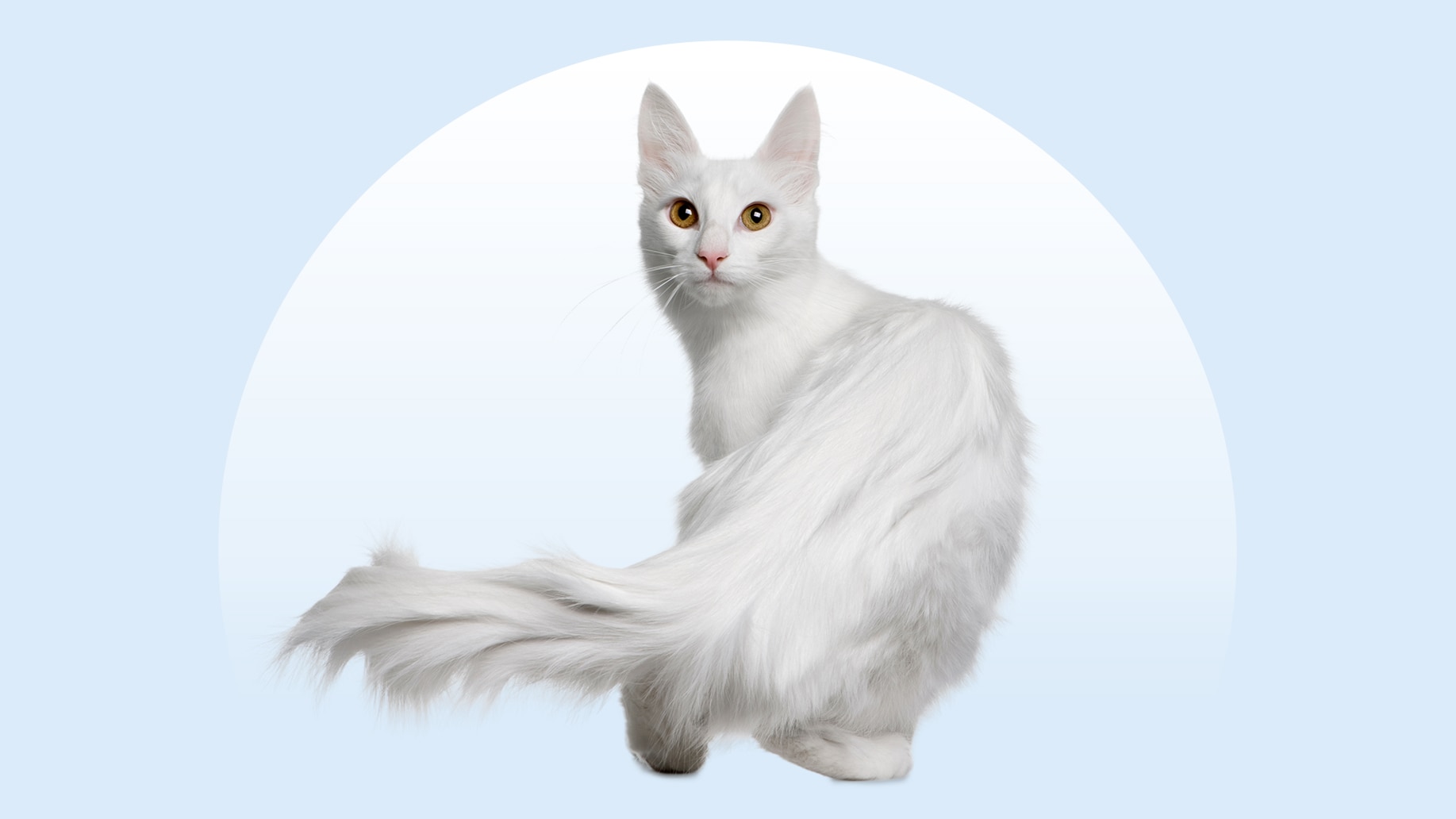
The Turkish Angora doesn’t just live in your home—like a grand piece of art, they elevate it. Silken fur draped over a slender frame, and topped with one of the floofiest tails you’ll ever see, the Turkish Angora is simply stunning. But unlike a work of art, this beauty is anything but passive.
Turkish Angoras will leap to the top of your kitchen cabinets, hold animated conversations with anyone in earshot, and make up their minds about something with absolute conviction. Shaped by centuries of roaming freely through the villages and countryside of Turkey, they remain instinct-driven, curious, and remarkably self-assured.
They’re also deeply affectionate, often bonding especially closely with one person in particular, who may quickly learn that being two seconds past scheduled snuggle time is a serious offense.
As beautiful as they are, the Turkish Angora isn’t for everyone. But for households that want a clever, communicative companion with a strong personality and plenty to say, there’s no cat breed quite like them.
Turkish Angora Characteristics
Turkish Angora Appearance
The Turkish Angora is a medium-size cat—slender, graceful, and deceptively athletic. While the white Turkish Angora with striking blue or odd-colored eyes is the most iconic look, they come in a wide spectrum of striking colors and patterns.
- Ears
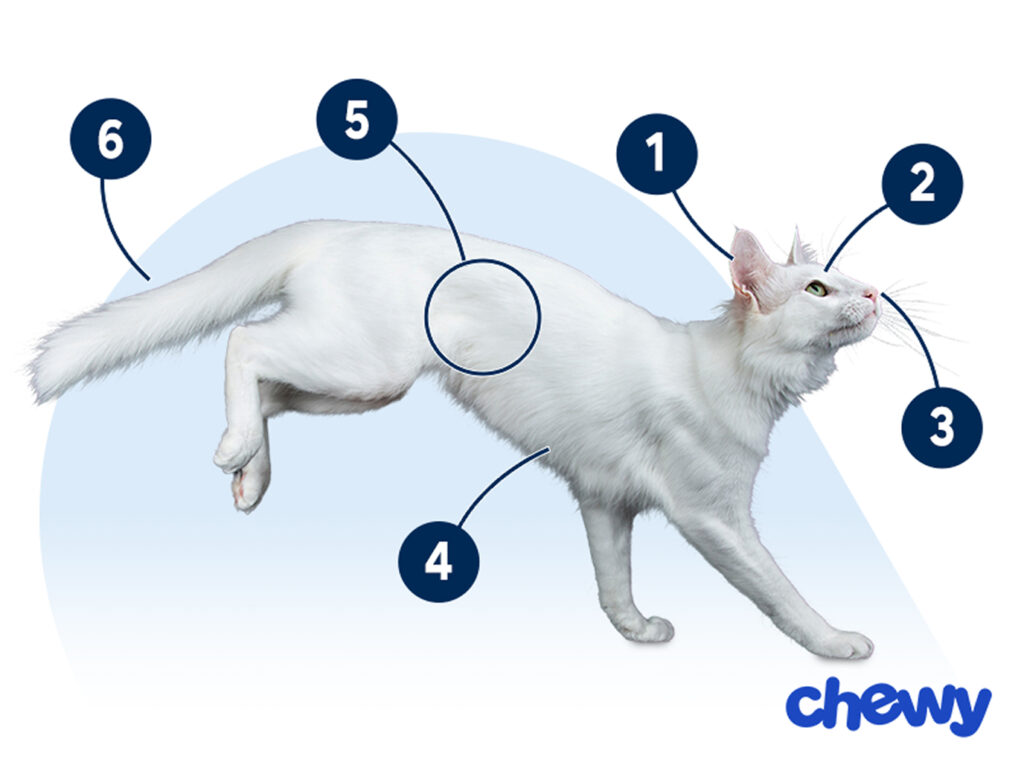
The Turkish Angora has large ears that are wide at the base and taper to a slightly pointed tip. They're set high on the head and have wispy tips.
- Eyes
Turkish Angoras have wide, almond-shaped eyes that angle slightly upward toward the ears. In most Turkish Angoras, eye color doesn’t correspond to coat color, though there’s one exception: The all-white Angora can have blue or two different-colored eyes, known as heterochromia. It's a striking look but may come with some health considerations; more on that below.
- Nose
Nose leather corresponds to coat color and may be pink, black, brown, blue, brick red, or rose.
- Coat Length
Turkish Angoras have semilong hair. It’s fine and silky with a slight undercoat, though they appear to be single-coated. This light, airy coat is thought to have developed as an adaptation to the climate of central Turkey, providing insulation in winter without the dense bulk seen in colder-climate breeds.
- Coat Color
Turkish Angoras come in all colors and coat patterns, from classic white to black smoke, tortoiseshell, calico, and more.
- Tail
Long and tapering from a wide base to a narrow tip, with a big, full plume.
Turkish Angora Temperament
These kitties are playful and affectionate, but that doesn’t necessarily mean they’re lap cats. While some take snuggle time very seriously, others prefer to stay close, even touching, without committing to being held.
Talking with your breeder about their cats’ personalities and early kittenhood socialization can give you a better idea of whether your future Turkish Angora is more likely to be a devoted snuggler, an independent companion, or somewhere in between.
What most Turkish Angoras seem to have in common, however, is that they love conversation. In fact, they are said to be the chattiest cat, just behind the Siamese.
Determined to have a genuine two-way conversation, many Turkish Angora caregivers find themselves learning the meaning behind different chirps, trills, and meows. Some go as far as teaching their Turkish Angoras to use communication buttons. But don’t say we didn’t warn you: This is a cat with plenty of thoughts and few reservations about sharing them.
If you don’t mind the conversation but prefer it at a reasonable volume, keep in mind that deaf cats often vocalize more loudly than hearing cats because they can’t hear their own volume. Deafness is more common in all-white cats with blue eyes.
Turkish Angoras are also famously headstrong—but not in an “I won’t do what you say” kind of way. They’re highly intelligent and often enjoy training, puzzle toys, and learning new tricks.
They have strong opinions—and absolute confidence in those opinions. They will choose a favorite human; insist on being involved in whatever is happening; and make their feelings known when something doesn’t meet their expectations. Once a Turkish Angora decides to do something, they’ll usually do it.
Well-socialized Turkish Angoras are often friendly and curious around adults, children, and even dogs. Some greet strangers as if they’ve been friends for years, even climbing onto a visitor’s shoulders the moment they’re within range. They may be more cautious when meeting other cats, but many warm up with proper introductions.
Related Breeds



How to Care for a Turkish Angora
Turkish Angoras make great household additions for solo caregivers, multipet homes, and first-time cat parents, as long as their social, mental, and physical needs aren’t underestimated. In return, you’ll never be lonely, bored—or without someone to talk to.
Grooming
Diet
Exercise
Environment
Turkish Angora Health
Turkish Angoras are a relatively healthy breed, with some living well into their 20s. Learning about common cat health conditions—as well as those specific to the Turkish Angora—can help you provide your companion with the longest, healthiest life possible.
- Hypertrophic cardiomyopathy (HCM): The most common form of heart disease in cats, HCM causes the heart walls to thicken. While there is no genetic test for HCM in Turkish Angoras, responsible breeders will not use parent cats with HCM in their breeding program. Beyond choosing a reputable breeder, the best way to detect HCM early is through routine heart screenings with your vet.
- Hereditary deafness: The same gene responsible for a Turkish Angora’s pure white coat and vivid blue eyes can also cause deafness. According to the Cornell Feline Health Center, around 80% of white cats with two blue eyes are deaf. In Turkish Angoras with heterochromia—one blue eye and one of another color—deafness often affects only one ear, typically on the same side as the blue eye. There is no treatment for hereditary deafness in cats, but with the right care and environment, deaf cats can live long, happy lives.
Turkish Angora History
The Turkish Angora hails from Angora—now the modern city of Ankara, Turkey. As a natural cat breed, they developed without human intervention while roaming the Turkish countryside for centuries. That is, until the early 1900s, when crossbreeding with other longhaired cats to improve the Persian coat nearly caused the Turkish Angora to disappear entirely.
Desperate to save their national treasure, Turkey established a breeding program at the Ankara Zoo, concentrating on white Turkish Angoras with blue, gold, and odd-colored eyes. The breed was successfully preserved, but such a treasure proved hard to share. By design, these treasured cats remained largely unknown outside of Turkey.
In the 1950s, American servicemen spotted the exquisite cats at the Zoo and couldn’t keep the secret to themselves, spreading word of the stunning white cats back to the United States. Still, it wasn’t until 1962 that the Ankara Zoo agreed to share their cats with the world. Colonel and Mrs. Walter Grant were the first to bring Turkish Angoras to the United States, receiving an odd-eyed white male named Yildiz and an amber-eyed white female named Yildicek (sometimes transliterated as Yildizcek), who would establish the Turkish Angora breeding program in America.
Today, the Turkish Angora can be a treasure in your own home, though finding one may take patience. Breeders are limited, waiting lists are common, and the price reflects both the rarity and the care that goes into responsible breeding.