Snowshoe Cat
Updated September 18, 2026
Snowshoe Cat
Updated September 18, 2026
Four white paws might be the Snowshoe’s claim to fame, but these personable kitties will steal the show with their friendly disposition. Developed from Siamese and American Shorthair ancestry, Snowshoes are rare and down-to-earth cat companions.
Social, Inquisitive, Affectionate
7–12 pounds
15–20 years
Your friends will likely ask if your cat is a Siamese (the two are closely related), but Snowshoe cats make a name for themselves with their friendly, mellow dispositions.
Far from being aloof and reclusive, expect your Snowshoe to be at the center of your family’s daily activities. These cats often enjoy playing with kids and following their pet parents around the house. They are active without being rambunctious, and many aren’t afraid to try new things, like going for a splash in shallow water or hitching a ride on your shoulders.
Snowshoe Cat Characteristics
Snowshoe Cat Appearance
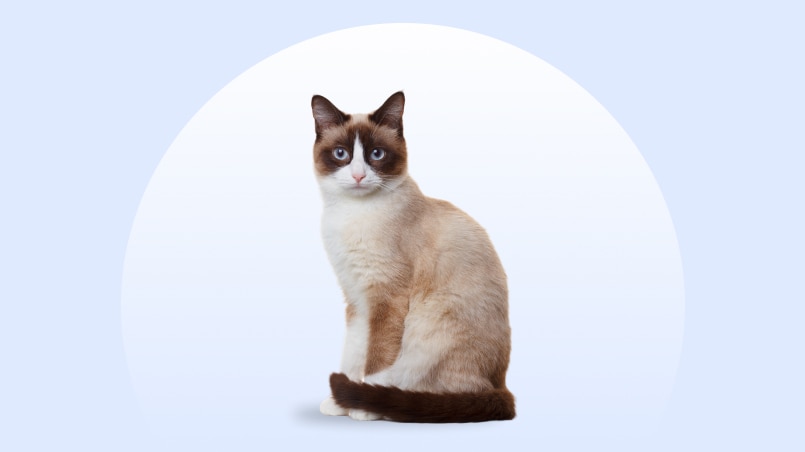
Snowshoe cats have a pointed coat and four white feet: These “snowshoes” are the breed’s defining trait. Many Snowshoe cats also have a white marking between the eyes that looks like an upside-down V.
Interestingly, Snowshoe kittens are born white, and their point coloring develops gradually over the first few weeks.
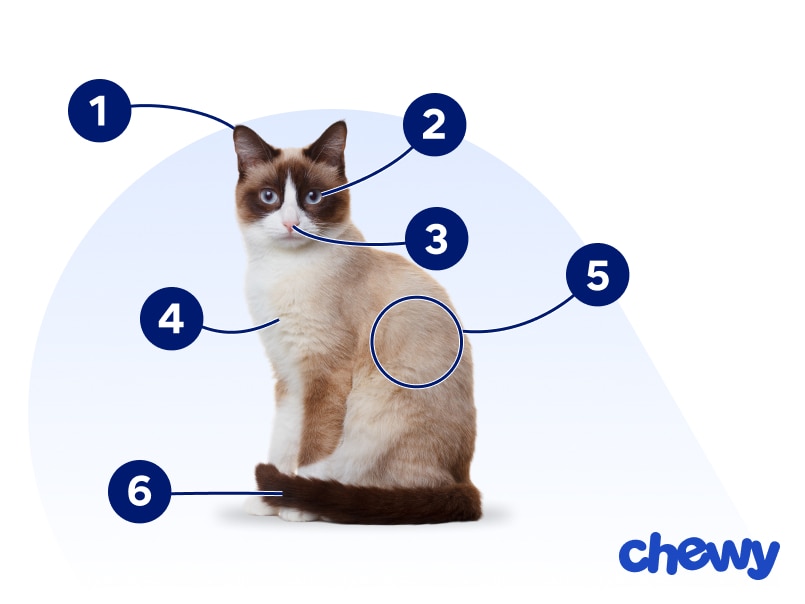
- Ears
The ears aren’t overly large or small and feature a slightly rounded tip.
- Eyes
Snowshoe cats have blue, oval-shaped eyes.
- Nose
The medium-sized nose is typically pink but might also match the color of the cat’s points.
- Coat Length
The coat is short and smooth.
- Coat Color
Snowshoe cats can have a variety of pointed coat colors, with seal and blue among the most common.
- Tail
The tail tapers slightly to a point.
Snowshoe Cat Temperament
Snowshoe cats have an easygoing personality and adaptable energy levels. They enjoy playtime and can easily be coaxed into a game with a feather teaser or ball toy, but they are also content to spend time lounging in your lap.
These cats are friendly and people-oriented. Especially with their human family members, Snowshoe cats are very “drapey” and are often content to be toted around in the crook of your arm, says Anne Graham, a Snowshoe breeder and the owner of PacificNorthwest cattery.
Other Snowshoe cats like to have a higher perch. Kate Gee, a Snowshoe breeder and owner of Sapphirestar Cats, describes some Snowshoes as parrotlike because they like to travel around by standing on their pet parents’ shoulders.
Some Snowshoe cats are very vocal, while others are much quieter. The Snowshoe has a polite nature that shines through even in their voice, which the breed standard describes as “soft and melodic.”
Related Breeds


How to Care for a Snowshoe Cat
Their affectionate, friendly personality means Snowshoe cats are easy to love—and it’s a bonus that they’re easy to care for, too. This breed doesn’t require much in the way of grooming since these cats keep clean and aren’t heavy shedders.
They’ll seek out your attention and readily play with toys, so plan one-on-one time with your Snowshoe cat each day for exercise and enrichment.
Grooming
Diet
Exercise
Environment
Snowshoe Cat Health
Many Snowshoe cats live 15–20 years, although some may live longer. Snowshoes are generally considered a healthy breed. A reputable breeder should be able to discuss the health history of their cats and any genetic screening appropriate for the breeding program.
- Polycystic kidney disease (PKD): PKD has been reported in Snowshoe cats. This inherited condition causes multiple fluid-filled cysts to develop in the kidneys and can eventually impair kidney function. There is no cure for PKD.
- Progressive retinal atrophy (PRA): This inherited eye disease causes progressive vision loss. Because Siamese cats have historically contributed to Snowshoe breeding, some Snowshoe breeding programs include PRA testing.
- Hypertrophic cardiomyopathy (HCM): This type of heart disease causes the walls of the heart to thicken, restricting blood flow. HCM is the most frequent type of heart disease in cats, and it occurs more often in some breeds than others, including American Shorthair cats. By extension, Snowshoe cats are at greater risk for this type of heart trouble. Routine veterinary examinations are the best way to detect early heart problems.
Snowshoe Cat History
The Snowshoe cat was born out of a litter of Siamese kittens in the 1960s, according to the Governing Council of the Cat Fancy.
A breeder in Pennsylvania observed three kittens with four white feet and took a liking to the look. From there, she set out to create a breed that would showcase white feet and pointed colors. There is little documented history about the Snowshoe’s development, but American Shorthair and Siamese cats contributed heavily to the breed’s development.
Today, the Snowshoe cat is recognized by several leading cat registries, including The International Cat Association (TICA).