Devon Rex
Updated July 7, 2026
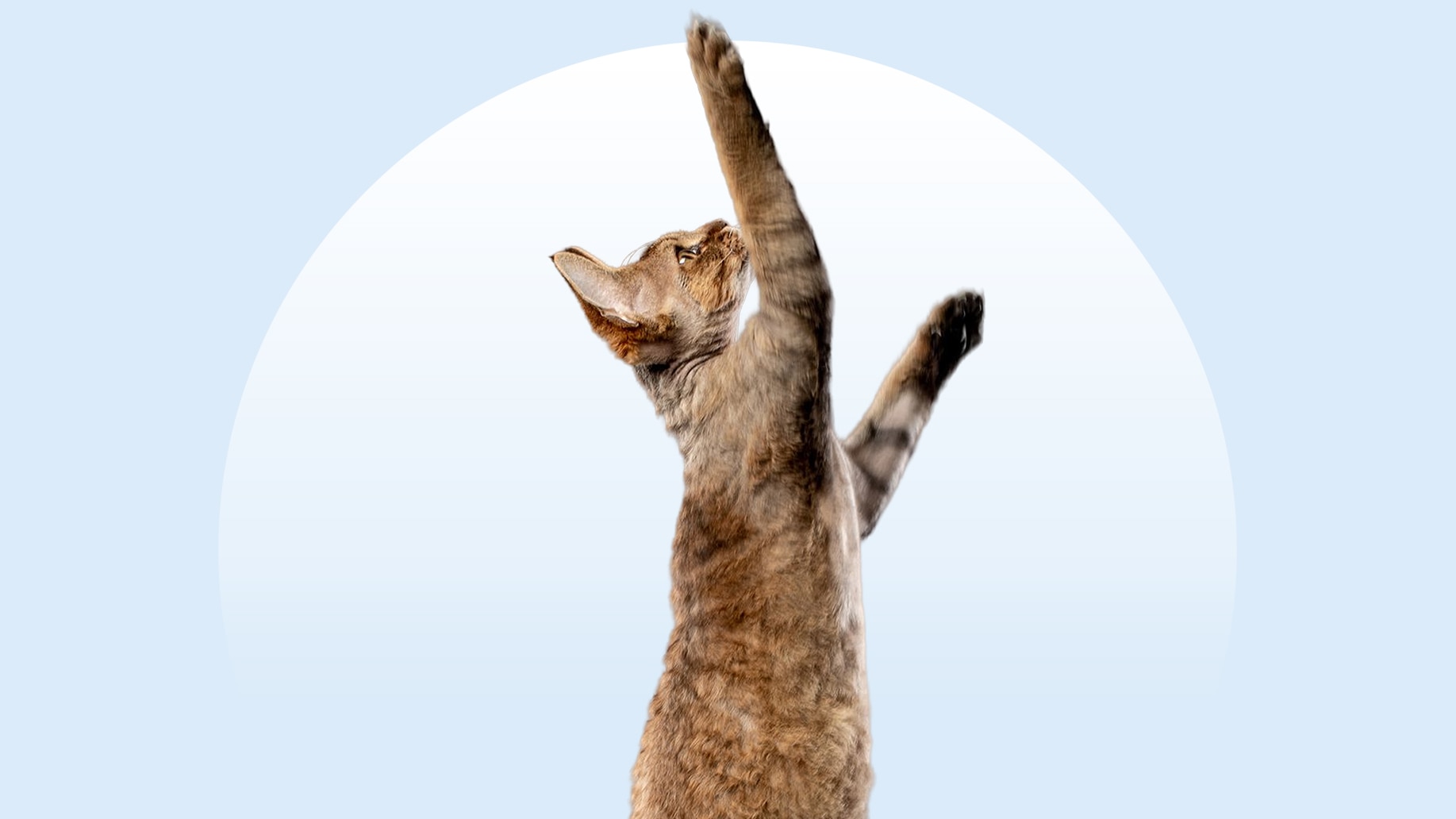
Devon Rex
Updated July 7, 2026
Looking for a cat who will be totally obsessed with you, head over paws? That’s the Devon Rex: equal parts cat, dog, monkey, and Dennis the Menace—and entirely Velcro. They thrive in solo homes or with kids and other pets, if they have a companion who is as invested in them as they are in you.
Sidekick, Intelligent, Curious
5–9 pounds
14–17 years
The Devon Rex is the kind of cat who “helps” you cook, supervises your shower, and critiques your work from your keyboard, all while being mere seconds away from doing something they shouldn’t. Sure, they might knock a pen off the counter just to watch it fall, but they’ll pounce right back into your lap (or perch on your shoulder) like nothing ever happened.
With enormous pixie ears, enchanting eyes, and a coat so soft you won’t mind the upkeep, the Devon Rex has a way of turning casual admirers into devoted fans. And if you need name inspiration for your new BFF, might we suggest Captain Underfoot?
Devon Rex Characteristics
Devon Rex Appearance
The Devon Rex is a small-to-medium, naturally curly-coated breed with a look that resembles a whimsical, elfin creature: They have enormous ears set low on a wedge-shaped head; large oval eyes; and a soft, wavy coat that can feel like peach fuzz, suede, a chinchilla, or warm rabbit fur depending on the individual cat and the day.
They are “rather unforgettable,” says Meghan Evans, a breeder at PureX Devon Rex, a TICA and Cat Fanciers Association-registered cattery.
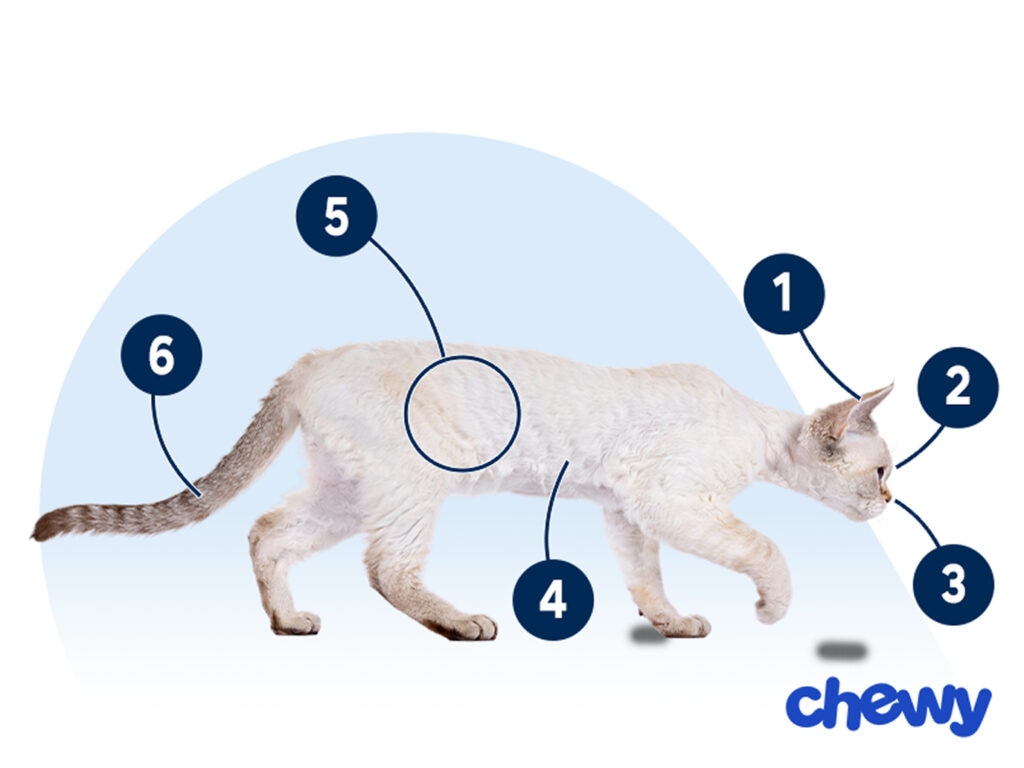
- Ears
Devon Rex have extra-large ears that flair out at the base and sit low on their wedge-shaped head. They’re covered in fine fur and may have wispy tufts at the tips.
- Eyes
Devon Rex have big, round eyes that come in shades of gold, copper, green, hazel, or blue.
- Nose
Their nose leather corresponds to coat color.
- Coat Length
These cats have full-bodied rexing, which means they have a coat with rippling waves and curls. The downy hairs densely cover the body, though the top of the head, neck, chest, and abdomen may have less fur.
- Coat Color
Devon Rex cats come in all colors and coat patterns.
- Tail
The Devon Rex has a long and tapering tail covered in fine fur.
Devon Rex Temperament
The Devon Rex is wholeheartedly a people-oriented cat. They form intensely strong bonds with their families and crave engagement in a way that can genuinely catch both first-time caregivers and seasoned cat parents off guard.
“I wish people understood how emotionally demanding they can be,” Evans says. “In the best way, but it is no joke.” They are not a cat who will be happy sitting in a corner being decorative. They want in—and on—everything. Boundaries don’t exist.
“A typical Devon Rex will want to follow you everywhere,” Evans continues. “Going to the bathroom? They will be with you for moral support.”
Because they’re highly social with high energy needs and big-time intelligence, they do best in homes where the activity level matches their own. According to Evans, that can include homes with kids, dogs, and other pets, or a second social kitty for your Devon to play with.
Of course, individual personalities vary. Evans says some Devons lean cuddly and Velcro; others are slightly more adventurous and mischievous: climbing and investigating with a general disregard for anything you’d prefer they leave alone. Yet, they all share a drive for connection.
Related Breeds




How to Care for a Devon Rex
Their unique coat comes with a fair amount of grooming—and combined with high social needs, Devon Rex cats ask for a moderate but real investment of your time and attention.
That said, grooming needs can vary greatly among individual cats depending on coat type and genetics. When purchasing a Devon Rex, ask about the parent cats’ coat condition and grooming needs. This can give you good insight into what to expect.
Grooming
Diet
Exercise
Environment
Devon Rex Health
The Devon Rex has an average lifespan of 14–17 years. Working with a reputable breeder significantly increases the chances of bringing home a healthy cat.
As with any breed whose popularity has grown quickly, demand can sometimes lead to breeding practices that prioritize quantity over quality. When searching for a Devon Rex kitten, a few red flags to watch for include:
- Breeders advertising unusually extreme or rare features and colors
- Unusually frequent litters (15 litters a year or more)
- A guarantee that the Devon Rex breed is always suitable for allergy sufferers or is completely hypoallergenic (which is not accurate for any cat breed)
That said, even when purchased from a reputable breeder, Devon Rex cats are prone to a few medical conditions. Purchasing pet insurance for your Devon Rex kitten can help offset costs down the road.
- Hypertrophic cardiomyopathy (HCM): The most common form of heart disease in cats, HCM causes the heart walls to thicken. Because there is currently no genetic test for HCM in the Devon Rex, ask your vet about preventive screening, and watch for symptoms like labored breathing, lethargy, or reduced appetite.
- Allergies: Devon Rex cats tend to develop skin allergies triggered by food ingredients or environmental allergens. However, Evans notes that allergies can sometimes be confused for normal Devon coat patterns, including areas of thinner hair growth or naturally sparse coverage in certain areas. When in doubt, consult your vet.
- Luxating patella: The Devon Rex has a higher tendency for luxating patellas, or loose kneecaps, than some other cat breeds. In mild cases, it may appear as a subtle sliding of the kneecap when walking. In more severe cases, it can present as limping, lameness, or complete dislocation. While cats can live comfortably with mild luxating patella, surgery may be recommended for severe grades. In either case, your vet may recommend a diet rich in omega fatty acids or glucosamine to help prevent early-onset arthritis. Keeping your cat at a healthy weight can also help slow progression of symptoms.
Devon Rex History
The Devon Rex is not to be confused with Cornish, Selkirk, and LaPerm Rex cats. According to Teresa Keiger, a CFA all-breed judge, “rex” refers to a curly coat, not a shared family lineage. “The term ‘rex’ was borrowed from the rabbit fancy, which originally used the term to refer to a curly coat,” she says. “So, with the exception of a coat that curls, they really have nothing in common.”
The Devon Rex’s story begins in the town of Buckfastleigh, in Devon, England. It was here that a random genetic mutation appeared in a feral tom cat living in an abandoned tin mine. In 1960, the tom and a tortoiseshell cat produced a litter of kittens—one of which had a curly, brownish-black coat. The kitten was named Kirlee, and according to TICA, all Devon Rex cats today trace their ancestry back to him.
Today, the Devon Rex holds the title of the most popular shorthaired cat breed, according to CFA registration statistics—a rank that does not surprise Evans. “It’s hard to ignore such a unique-looking cat,” she says.