Saluki
Updated July 16, 2026

Saluki
Updated July 16, 2026
Salukis are elegant and independent pups who can reach lightning-fast speeds. They need ample exercise and thrive in quiet homes with experienced pet parents who understand their sensitive nature and can provide space to run.
Calm, Graceful, Sporty
40–65 pounds
Up to 28 inches
10–17 years
Black and Tan, Black Tan and White, Cream, Fawn, Golden, Red, Silver, White, Chocolate, Chocolate and Tan, Black, Black and Silver
With their sleek physique, Saluki dogs might look like they belong on the red carpet—but don’t let their delicate features deceive you. These dogs are Olympians at heart; as one of the fastest dog breeds, they can zoom at speeds up to 40 mph and jump a 4-foot fence with finesse.
But that doesn’t mean you have to be an Olympic sprinter, too. They’re happy if you just watch from the sidelines. These graceful canines aren’t all-race-no-snuggles, either. After a day of run-play-rinse-repeat, these gentle dogs are content to chill with you for a movie marathon.
Saluki Characteristics
Saluki Appearance
Salukis are the epitome of athletic elegance, and their short, straight coat is neatly offset by wisps of feather on the legs and tail. Their soulful eyes hint at this dog’s high intelligence.
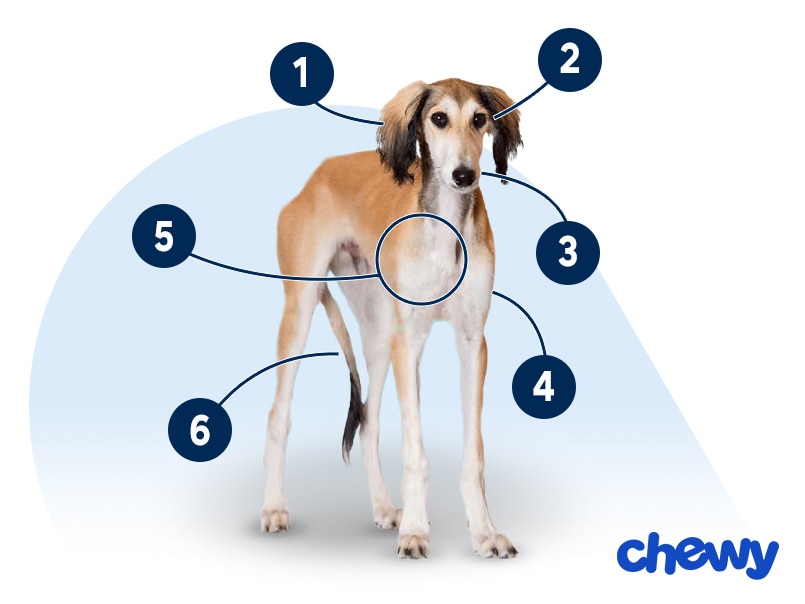
- Ears
Saluki ears are covered in soft, cascading strands that frame their delicate faces.
- Eyes
Saluki eyes are large, oval, and expressive. Colors range from almost black to bright hazel.
- Nose
Their muzzles are long and narrow with black or liver (brown) noses.
- Coat Length
Saluki coats may be smooth or feathered. The feathered variety has a short, straight coat with a hint of feathering on the legs and at the back of the thighs with longer feathering of the tail. The smooth variety has little to no feathering and closely resembles a Greyhound or Whippet.
- Coat Color
Saluki colors run the gamut, including white, cream, fawn, golden, red, tricolor (white, black, and tan), and black and tan.
- Tail
Salukis have a long tail with a soft, feathered plume of fur on the underside. Salukis typically carry their tail at a natural curve.
Saluki Temperament
Salukis are an exceptionally sweet breed; they tend to be quiet and reserved, and they’re a little shy until they get to know someone better.
They’re said to be incredibly emotionally intelligent, and they may know better than anyone when you’re having a rough day—and be there for snuggles at the end of it.
These pups tend to bond closest with one family member, and they can get separation anxiety if their person leaves them for extended periods—so it’s ideal if they can go along with you. You could also drop them at their favorite doggy daycare or hire their favorite pet sitter.
Loyal companions, Salukis are excellent dogs for calm, chaos-free households. So, they might not do best with young, loud children. They also have a strong prey drive that might make living with smaller animals tricky unless introductions are done properly.
Despite their low-key attitude, they are sporty and require a place to run (whether in a fenced backyard or a nearby dog park), so you’ll need to make sure they have the space to be their graceful, active selves.
Related Breeds




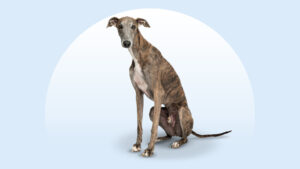
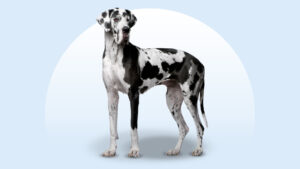


How to Care for a Saluki
Salukis don’t need a ton of grooming, but they do need a good bit of exercise and training.
Grooming
Training
Diet
Exercise
Environment
Saluki Health
The average Saluki life expectancy is 10–17 years. Here are some health issues to be aware of.
- Bloat and gastric dilatation-volvulus (GDV): Salukis, like many deep-chested breeds, are prone to a life-threatening condition called bloat, when the stomach distends with air and/or food. A serious complication of bloat is gastric dilatation-volvulus, when the stomach twists on itself, cutting off blood supply to the organs. Symptoms include abdominal distension, restlessness, and dry heaving. If you notice these signs, go to the vet immediately.
- Cancers: Saluki dogs are prone to a few different types of cancers, including lymphoma, hemangiosarcoma, osteosarcoma, and mammary cancer. Treatment depends on the condition, but it may include surgery, chemotherapy, radiation therapy, or palliative care. Cancer treatment for pups has come a long way in recent years, so outcomes are often hopeful.
- Dilated cardiomyopathy: Dilated cardiomyopathy is a genetic condition where the heart enlarges and can result in heart failure. Diagnosis is based on an echocardiogram, and treatment is often daily medication.
- Hip dysplasia: Hip dysplasia is when the ball and socket of the hip and thigh bones don’t properly fit. It’s an inherited condition that can be made worse if a pup is overweight. It eventually leads to arthritis and pain. More severe cases may require surgery, but the condition is often treated with medications, joint supplements, special diets, weight management, and/or physical therapy.
- Neuronal ceroid lipofuscinosis (NCL): NCL is an inherited and progressive neurological disorder that usually shows symptoms at 1–2 years of age. The most obvious symptom is behavioral changes in the dog, and the pup will usually lose coordination and eyesight. There is no current treatment, but see your vet ASAP if you suspect something is off.
Saluki History
If the Saluki’s majestic mug has an air of royalty, you’re not imagining things: The Saluki dog breed was once a favorite among famous rulers like Alexander the Great. For centuries, these noble animals graced the palaces of royal families of the Middle East and sat throne-side among pharaohs.
Archeologists have found ancient artifacts, including sculptures and paintings, that depict slender dogs with feathered, Saluki-like features. Possible Saluki mummies have also been discovered in tombs. Experts believe the Saluki may be one of the oldest domestic dog breeds in the world.
Also known as Persian Greyhounds or Gazelle Hounds, these pups were originally bred in the Middle East as sight hounds for hunting. (Sight hounds are dogs who hunt by sight instead of by following their nose, as a Beagle would.)
Saluki puppies can cost thousands of dollars. If you choose this route, pick a responsible breeder.
There are also Salukis already waiting for their forever homes. Look for a Saluki rescue like STOLA, keep an eye out at your local animal shelter, or search Chewy’s database of adoptable dogs in your area.