Balinese Cat
Updated September 15, 2026

Balinese Cat
Updated September 15, 2026
The Balinese is a sweet, loyal cat who’s always up for hanging out with—or perching on—their favorite person. With high social needs and a love for play, they shouldn’t be left alone for long. Ideal homes include families with kids, remote workers, or multi-pet households.
Loyal, Energetic, Chatty
5–12 pounds
10–20 years
Their name might suggest they come from Bali, but the Balinese cat was actually named after the graceful dancers of the Indonesian island. With shimmering blue eyes, a silky low-shedding coat, and an elegant and slender build, they’re equal parts beauty and grace—just like their namesakes.
But grace doesn’t always come quietly. Balinese aren’t shy about sharing their thoughts when they’re bored or want your attention. They’re happiest in homes where someone is around most of the day, and they tend to make friends with respectful children, other cats, and cat-friendly dogs, especially those who love to play as much as they do.
While no cat is truly hypoallergenic (all cats produce Fel d 1, the primary protein responsible for cat allergies), some people with mild cat allergies might be less affected by Balinese cats because they shed less and produce less Fel d 1 than many other breeds.
Balinese Cat Characteristics
Balinese Cat Appearance
A sleek silhouette, sapphire-blue eyes, and a classic color-point pattern—does the Balinese look familiar? That’s because the breed is a longhaired Siamese cat.
If you breed two Siamese who both carry the recessive longhair trait, they can produce long-haired—aka Balinese—kittens, says Lisa Young, founder of CFA-registered Thai Dee Maew Cattery. That trait gives them a longer coat and their signature plume tail.
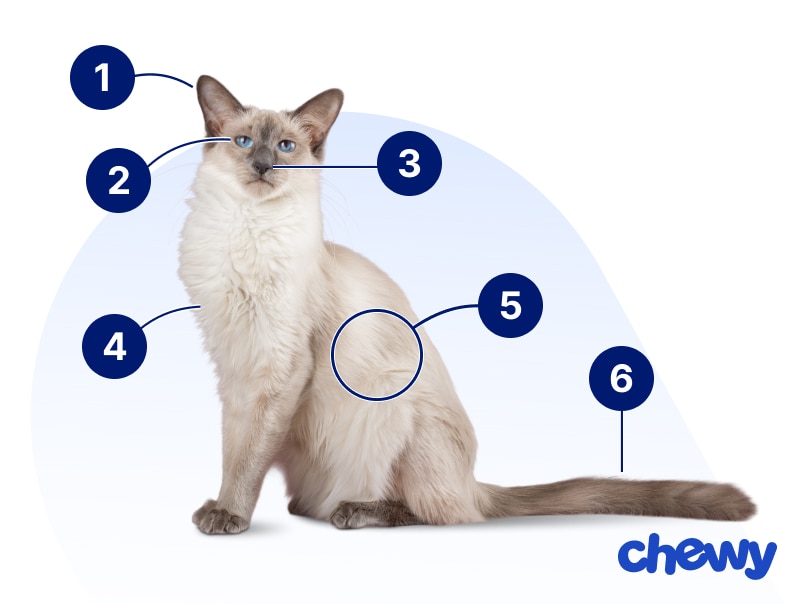
- Ears
Balinese cats have large, pointed ears—perhaps perpetually tuned into the sound of a treat bag.
- Eyes
Their almond-shaped eyes are always blue.
- Nose
Their nose leather corresponds to their coat pattern, ranging from pink to darker shades of gray or brown.
- Coat Length
Balinese cats have a single-layer, semilong coat that’s silky and lies close to the body. Without an undercoat, they need less grooming than many other long-haired breeds.
- Coat Color
Balinese cats have a lighter-colored body with darker points on their ears, face, paws, and tail. Like their Siamese relatives, their classic color patterns include seal point (deep brown to black), chocolate point (milk-chocolate brown), blue point (slate gray), and lilac point (pinkish gray).
- Tail
Their long tail fans out like a feather, creating their signature showstopping plume.
Balinese Cat Temperament
Every Balinese has their own unique personality, but a few traits tend to shine through: They love to chat, they love to play, and they absolutely love their people.
The apple (or kitten) doesn’t fall far from the tree—the Balinese share many of the Siamese’s signature traits, including their intelligence, curiosity, and social nature. Some describe the Balinese as having a slightly softer temperament than the Siamese, but others are just as energetic, playful, and vocal as their short-haired relatives—just wrapped in a silky coat.
“The Balinese are very social,” Young says. “They want to be around their people 24/7. They’re cuddly, they’ll follow you everywhere, and they’ll chat with you.”
If you’re looking for personal space, a Balinese may have other plans. “They might want to watch you shower, go to the bathroom with you, or just literally sit at your feet while you make dinner at night—then immediately want to be on your lap,” says April Tinnin, owner of TICA- and CFA-registered Sapphire Kittens Cattery. “Some will even climb on your shoulders.”
If you’re looking for a social, emotionally connected cat who wants to be involved in your life, the Balinese could be a perfect fit.
Related Breeds






How to Care for a Balinese Cat
Their silky coat typically only needs a quick weekly brushing. So with less time spent grooming, you’ll have more time for what Balinese cats love most: interactive play, cuddle sessions, and being wherever you are.
Grooming
Diet
Exercise
Environment
Balinese Cat Health
Balinese are among the healthiest cat breeds and have been known to live 20 years or more. Still, there are several potential health issues to be aware of. Knowing what could affect your cat and how to keep them healthy can help you give them the longest and happiest life possible.
- Amyloidosis: Amyloidosis occurs when protein deposits in organs, particularly the liver and kidneys. There’s no way to prevent amyloidosis or screen for it with a genetic test, but annual vet visits and blood work can catch it early. While cats of any age can develop amyloidosis, it predominantly affects cats 7 years or older.
- Eye issues: Some Balinese are born with crossed eyes that, while often benign, can occasionally affect their vision. A more serious concern is progressive retinal atrophy (PRA), which causes the retina to gradually degenerate and leads to blindness. Reputable breeders will genetically test their breeding cats to prevent this from being passed to Balinese kittens.
- Pica: It’s not unusual for kittens to explore their surroundings orally, often by chewing. But if your Balinese cat or kitten is ingesting non-food items, such as cat litter, strings, or plastic, they may have pica. This behavior can lead to life-threatening gastrointestinal blockages, so talk to your vet immediately if you notice it.
Balinese Cat History
While the history of the Siamese is well-documented (they are widely considered the oldest recognized cat breed), the history of the Balinese isn’t so clear.
Longhaired kittens had likely appeared sporadically in Siamese litters for centuries due to a naturally occurring gene mutation, but the earliest record of a longhaired Siamese doesn’t appear until 1928, when one was registered with the Cat Fanciers’ Federation (CFF).
That changed in the 1950s, when the Balinese became an official breed. But even that history has some conflicting details: breeders Helen Smith and Sylvia Holland are credited by the CFA with developing the breeding program, while TICA credits Smith and Marion Dorsey.
One thing is clear, however: the origin of the name. The breed was named “Balinese” after the graceful dancers of Bali.