5 Best Small Pet Birds


Photo by iStock.com/Pawzi
The perks of keeping small pet birds are endless. Pet birds are generally less expensive than other pets, says Tiffany Latino, owner of The Bird Shop in Sacramento, California. “They’re less noisy, they don’t take up as much space, and they make great pets,” Latino says.
Small pet birds are often ideal for first-time bird keepers and pet parents, or those with small apartments—and they can be taught to whistle and even talk! Do you live in a small place and like to travel a lot? Don’t have time to walk a dog three times a day? A small pet bird might be the ideal choice for you.
With so many types of pet birds choose from, which species should you bring home? Here are the five best pet birds for those looking for a pint-sized pet.
Key Takeaways
- The best small pet birds include cockatiels, canaries, parakeets, finches, and green-cheeked conures.
- Cockatiels are the most popular choice in America while parakeets are the most popular small pet bird around the globe.
- Parakeets are the chattiest small bird on our list—a parakeet holds the world record for the largest vocabulary.
- If you prefer a small pet bird that's cuddly, choose a cockatiel or a green-cheeked conure.
- Canaries don't love to held and are, as a result, low-maintenance pets who are known for their cheerful singing.
1. Cockatiels

Wang LiQiang/Shutterstock.com
Cockatiels are one of the most popular pet birds in America. These cuddly parrots are silky soft thanks to what’s called powder down, which helps keep their feathers waterproof. Cockatiels are one of the most easy-going of the small pet birds, just as content with whistling to themselves in a mirror as they are riding around on your shoulder.
Male cockatiels are amazing whistlers, too—check out any cockatiel video on YouTube—and can be taught any number of songs. Females aren’t known for the extravagant whistling of their male counterparts, but they are no less affectionate or cuddly.
Cockatiels can live up to 20 years, and their full size is about 13 inches long from beak to the tip of tail feathers. Another interesting fact: They’re the only small parrot with a head crest.
Common Cockatiel Colors
Cockatiels come in many colors. Their normal color is gray; the other colors are a result of mutations.
- Gray Cockatiels (also known as nominal): This is the normal color of cockatiels, like ones you’ll see in their native Australia habitat. They are gray with a splash of white on their wings and have a yellow face with orange cheek patches.
- Pied Cockatiels: A mutation that results in a pattern of gray and white blotches on the bird’s wings. There are variations of pied cockatiels.
- Pearl Cockatiels: A mutation that results in white and yellow scalloped shape patterns on the bird’s wing feathers.
- Cinnamon Cockatiels: A mutation that results in more brown than gray tones.
- Albino Cockatiels: A mutation in which the cocktail is all white with black eyes.
- Lutino Cockatiels: A mutation that results in a yellow-white color with orange cheek patches and red eyes.
There are also variations of mutations, such as pearl-pied, cinnamon-pearl, lutino pied, etc.
2. Parakeets (Budgerigars)

Vyaseleva Elena/Shutterstock.com
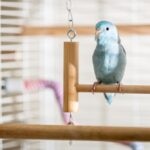
Perhaps the most popular pet bird in the world, the parakeet, or budgerigar, is also one of the best talking parrots. A budgie even reportedly holds the world record for the largest vocabulary of any bird at 1,728 words. The only problem? It can be incredibly hard to hear them with their teeny-tiny voices.
They’re also incredibly active little birds, especially compared to their fellow Australian cousins, the cockatiels. Don’t be surprised to see them bouncing across bird perches, playing with toys, banging around a bell like it offended them, or throwing their parrot bird food around to find their favorite pieces.
When they do settle down for a nap, try to listen in on them: Often they’ll practice the words and sounds they’ve learned while dozing.
How To Tell Male and Female Parakeets Apart
Parakeets are one of the few parrots where it’s generally easy to see which ones are males and females. Males have blue to purple “ceres,” which the part right above their beaks where their nostrils are. Females have brown to pink ceres, though sometimes there may be hints of blue, too.
Unfortunately, this sexing technique can’t be used on young parakeets, as the cere turns colors when they reach sexual maturity. And male budgies sometimes have pinkish ceres depending on their overall color. If you want to know what your parakeet is, the best way is to tell is to use a DNA test.
English Budgerigars vs American Budgies
You’ll often see in pets stores what is commonly known as the American budgie. They have slim bodies and come in a variety of colors, from blues, to greens, whites, and yellows.
English budgerigars are larger than the American parakeets, which are much closer in size and features to the wild Australian budgerigar. English budgies typically are the birds seen in exhibitions and shows, but they are just as good as pets as their smaller counterparts. Both types of parakeets can live up to 10 years.
3. Canaries

Hermansyah28/Shutterstock.com
If you are more of a hands-off pet owner, a canary might be perfect for you. Canaries with their gentle natures and sweet sounds can appeal to any person, even though they don’t typically like to be held.
“People enjoy watching them,” Latino says.
Canaries are popular for another reason: The males are amazing singers, and can fill a house with bird songs during spring. If you have two male canaries, they’ll even compete with each other to produce the best song. However, the two must be in separate bird cages or they will fight during the breeding season. Outside the breeding season, it’s possible to keep them together but not recommended.
Female canaries aren’t singers, but they do make adorable chirping noises. Unlike males, females can be kept together without any problems. Avoid keeping male and female canaries together, especially if you want to avoid baby canaries.
Canaries come in a variety of colors, from pure yellow, bright red, brown and yellow, to pure white. There are also different type of canaries: Some have sleek feathers, while others have feathers that look like a mop top. Their lifespan is around 10 years.
4. Finches

Wang LiQiang/Shutterstock.com
Finches have been kept as pets for many years. The first domesticated finch was most likely the Bengalese or society finch, which are still popular today.
Finches, like their cousins, the canaries, are hands-off pets, but can bring delight to any household. They are incredibly popular for their chirps and songs, their variety of colors and personalities. They are also easy to care for, with lifespans around 10 years.
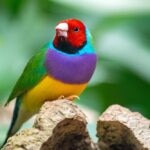
One of the most popular finches is the zebra finch, which are gray and white birds with bright orange beaks and, in males, orange cheek patches. Society finches, which have a known for their gentle natures, and the Lady Gouldian finches, which come in eye-popping colors, are also very popular.
Unlike canaries, finches need to be kept with at least one other finch. They are incredibly social animals, and need to stay together. Due to their tiny size, it’s easy to keep a whole group of finches together in a bird cage. However, you should try to only have the same species together. Certain finch species may pick on another species if given the chance.
5. Green-Cheeked Conures

Ery Azmeer/Shutterstock.com
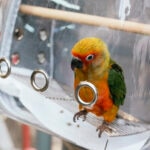
Rounding out our top five list is the green-cheeked conure, a small parrot that is native to South America. Green-cheeked conures have been described by some as the perfect pet bird, and great family birds, too.
They are active little parrots who love to play with their bird toys, go exploring and wrestling with your finger or another conure. When they’re settling down for a nap, they’ll gladly cuddle up on your shoulder or under your chin.
These rambunctious parrots are on the quieter side compared to other conures (like the sun conure), and can even learn to talk. They are also highly intelligent and can be taught a variety of tricks, such as putting a toy basketball in a hoop. Their curiosity and intelligence should be fed with puzzle toys and foraging items.
When bringing home a green-cheeked conure, plan for the long term. Green-cheeked conures live for a long time — up to 30 years! They’ll be part of your family for a long time — maybe even a couple generations of family!
FAQs About Small Pet Birds
What are the best small pet birds for beginners?
Cockatiels, parakeets (also called budgerigars, or budgies), canaries, finches, and green-cheeked conures can all be good choices for first-time bird keepers who want a small pet bird.
Budgies and cockatiels are often suited to people who want interactive companions, while canaries and finches may be better for pet parents who prefer a more hands-off pet.
What is the easiest small bird to take care of?
Canaries and finches can be appealing to pet parents who prefer a more hands-off pet, since they are less inclined to enjoy being held or cuddled. Parakeets (budgies) may suit those who want more interaction, as they can be talkative, active, and playful.
However, all pet birds need fresh food and water, a clean cage, daily enrichment, and routine veterinary care.
What is the quietest small pet bird to keep?
Finches and canaries are worth considering if you prefer a quieter home. Although parakeets can be talkative, they have relatively quiet voices. Cockatiels typically produce a range of chirps and whistles, while green-cheeked conures can be vocal, though they’re quieter than some other types of conures.
Which small pet birds are the most affectionate?
Cockatiels and green-cheeked conures can form close bonds with their caregivers and some enjoy perching on shoulders, cuddling, or learning tricks.
What small pet birds can learn to talk?
Parakeets (budgies) are well known for mimicking human speech, and one budgie holds the world record for having the largest vocabulary. Some green-cheeked conures can learn words and sounds, while cockatiels are known for whistling and mimicking tunes.
As with any pet bird, their ability to talk depends not only on their species, but also on the individual bird’s personality and training, and not every bird will learn to talk.
What is the best small pet bird for an apartment?
Cockatiels, parakeets (budgies), finches, canaries, and green-cheeked conures are among the small pet birds that may be suited to apartment living.
Before choosing a pet bird, consider how much their species typically vocalizes, your tolerance for noise, the bird’s daily activity needs, their cage size relative to your available space, and your building’s pet rules.
How long do small pet birds live?
Lifespans vary by species and individual bird. Prospective pet parents should consider the long-term commitment of caring for a pet bird.
Parakeets (budgies) and finches often live up to 10 years, canaries live about 10 years, cockatiels commonly live up to 20 years or longer, and green-cheeked conures may live up to 30 years.
What supplies do you need before bringing home a small pet bird?
Start with an appropriately sized cage, safe perches, species-appropriate food, fresh water dishes, enrichment toys and bird-safe cleaning supplies. You should also identify an avian veterinarian and learn about your bird’s dietary, exercise, and social needs before bringing them home.
Can small pet birds live alone, or should they be kept in pairs?
It depends on the species and the individual bird’s preferences and personality. Cockatiels, for example, are flock animals that may bond with a companion bird, although keeping a male and female together may lead to breeding. Finches are generally very social and do best with compatible finch companions.
Talk to your veterinarian about your bird’s species-specific social needs, compatibility with other birds, and how to introduce a companion, if appropriate.
Are small pet birds low-maintenance pets?
Small pet birds may require less space than larger pets, but they still need daily care, cage cleaning, playtime, enrichment, a healthy diet, and regular veterinary visits.
Some species also need regular social interaction with their human caregivers, including supervised time outside their cages, or with compatible bird companions.
Attributions